List January 2026
|
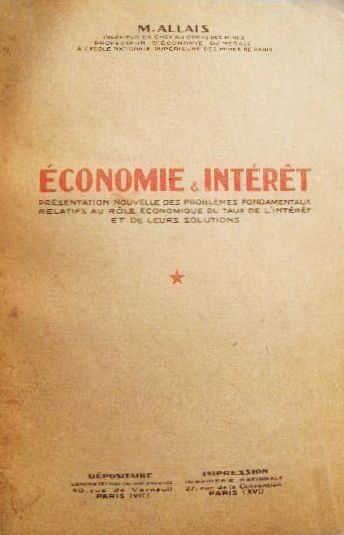
Second major book of the 1988 Nobel Prize in economics
laureateALLAIS, Maurice (1911-2010)
Economie & intérêt. Présentation nouvelle des problèmes
fondamentaux relatifs au rôle économique du taux de l'intérêt et de leurs solutions.
Paris, Librairie des publications officielles, Imprimerie nationale [1947].
2 volumes. 422; [423]-800p., continuously paginated. Orig. printed wrappers. A fine set.
(#34033)
€ 2000
First edition. Second major book of Maurice Allais, winner of the 1988 Nobel Prize in economics for his
'pioneering contributions to the theory of markets and efficient utilization of resources'. In it, he 'showed that the
optimum interest rate for a no-growth economy would be 0 percent. Real income is accumulated most efficiently
when the interest rate is equal to the growth rate of the economy ... This is the first version of the golden rule of
accumulation obtained by Phelps some fourteen years later.' Since Allais wrote in French only his contributions
to economic theory became widely acknowledged only when they were rediscovered by English-speaking
economists. Paul Samuelson noted that had Allais written in English, 'a whole generation of economic theory
would have taken a different course'.
*New Palgrave I,p.79.
|  |
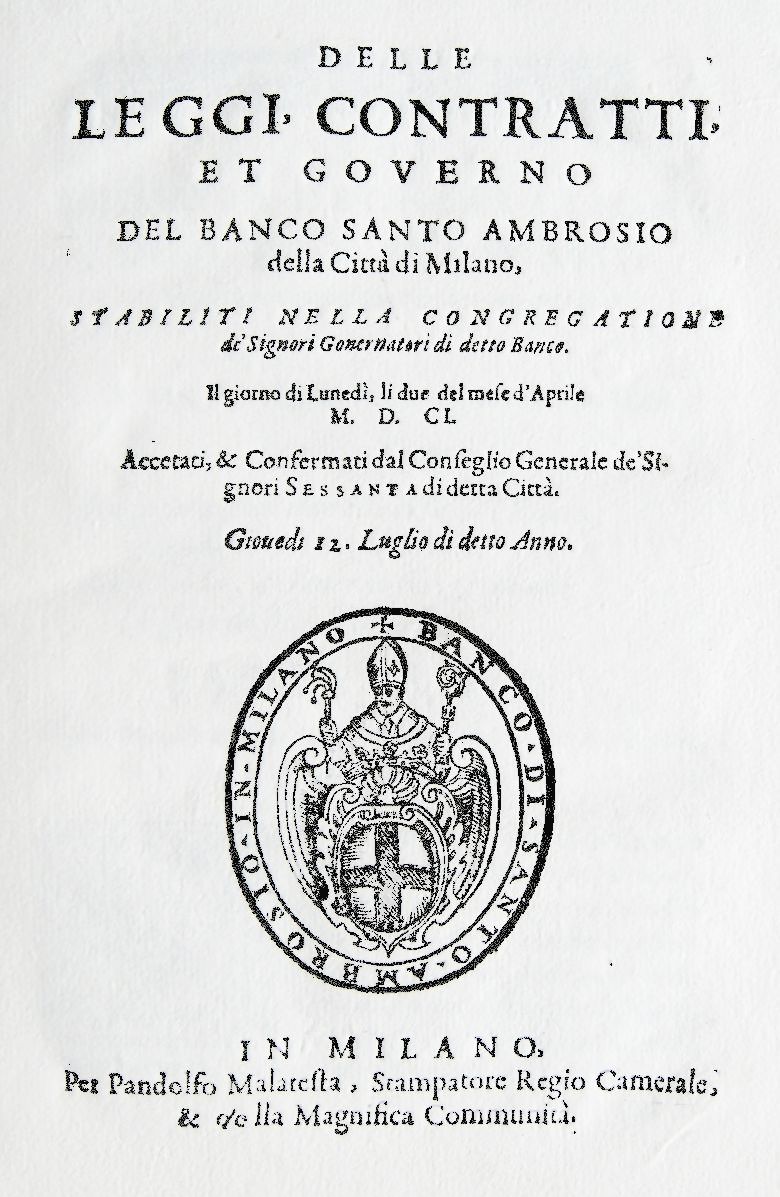
Early Italian bankingBanco di Santo Ambrosio.
Delle leggi, contratti, et governo del Banco Santo Ambrosio della citta di Milano, stabiliti nella
congregatione de' Signori Gouernatori di detto Banco. Il giorno di Lunedi, li due del mese d'Aprile M.D.CI.
Accetati, & confermati dal Conseglio Generale de' Signori Sessanta di detta città. Giovedi 12. Luglio di
detto anno.
In Milano, per Pandolfo Malatesta [1601].
4to. 36,[11 patent by Juan de Velasco]p. Title with woodcut device of the bank, and several
woodcut initials and ornaments in the text. Contemp. carta rustica. Printed on fine paper. (#31168)
€ 2500
First edition. One of the earliest printed documents relating to public banking. It contains the statutes,
by-laws and governance of the Bank as well as details about its establishment.
The Banco Santo Ambrosio was one of the earliest public banks, established in 1598 upon the theories of
Giovanni Antonio Zerbi. Zerbi was a Milanese merchant who had studied the Spanish and Sicilian banks and
especially the bank of San Giorgio of Genoa. He published his theories on banking in 1599 as Discorso in
forma di dialogo intorno al Banco S. Ambrosio della citta di Milano. Unfortunately the results of the bank
were unsatisfactory and it was almost bankrupt in 1630.
*Goldsmiths'-Kress 00305.1. Kress 238. Kress, Italian 99. Palgrave III,p.691 (Zerbi).
|  |
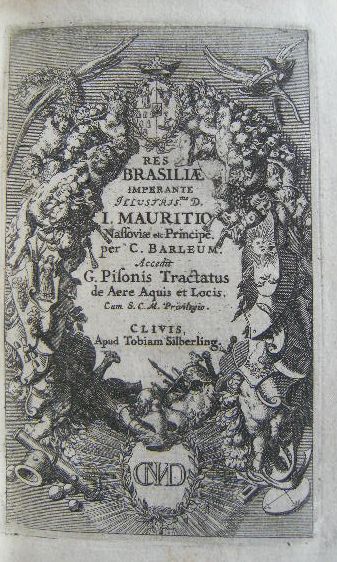
The Dutch in BrazilBARLAEUS, Caspar (1584-1648)
Rerum per octennium in Brasilia et alibi gestarum, sub praefectura illustrissimi Comitis I. Mauritii,
Nassauiae &c. Comitis, historia. Editio secunda. Cui accesserunt Gulielmi Pisonis medici Amstelaedamensis
tractatus 1. De aeribus, aquis & locis in Brasilia. 2. De arundine saccharifera. 3. De melle silvestri. 4. De radice
altili mandihoca.
Clivis [Kleve], Tobiae Silberling 1660.
Small 8vo. [XII],664,[21]p. With engraved title, portrait and coat-of-arms, 3 folding engraved
maps (South America and the Western part of Africa, Brazil under Dutch rule, and Mauritiopolis, Recife and
surroundings) and 5 folding engraved views. Contemp. vellum, back with red label. With bookplate of the
famous book collector John Carter Brown (and his name stamp in red on the verso of the portrait), and bookplate
of the book and art collector M. Pimenta Camargo. Without the plate of a sun-eclipse present in part of the
copies. (#34387)
€ 4500
  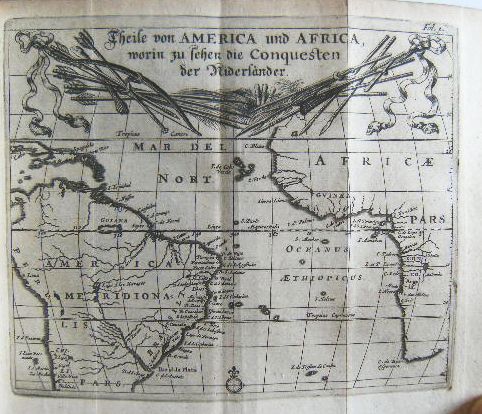 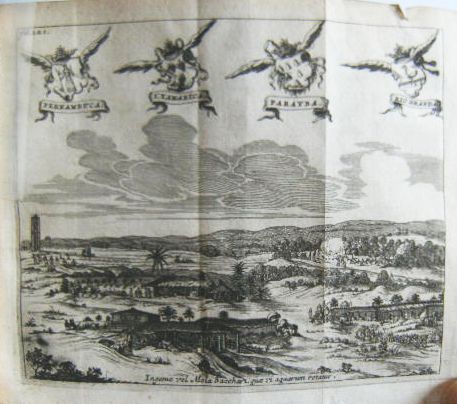
Second Latin edition of this famous history of Dutch rule in Brazil under Johan Maurits van
Nassau from 1637 to 1644. The first edition in folio is extremely rare and valuable, since most copies and the
plates were lost in a fire at the workshop of the printer Blaeu. The plates and maps of this edition are identical
with those in the German edition of 1659. The plate of the sun-eclipse was not present in that edition and seems
to have been added to a part of this Latin edition only. The present edition has added some contributions to the
natural history of Brazil by Johan Maurits' physician Willem Piso.
*Sabin 3409.
BEHR, Wilhelm Joseph (1775-1851)
Die Lehre von der Wirthschaft des Staats oder pragmatische Theorie der Finanzgesetzgeburg und
Finanzverwaltung. Mit Rücksicht auf den Gebrauch bei akademischen Vorlesungen bearbeitet.
Leipzig, F.A.Brockhaus 1822.
Small 8vo. XXIV,294,[4]p. Contemp. half calf, gilt back with red label, marbled sides.
(#30409)
€ 175 |  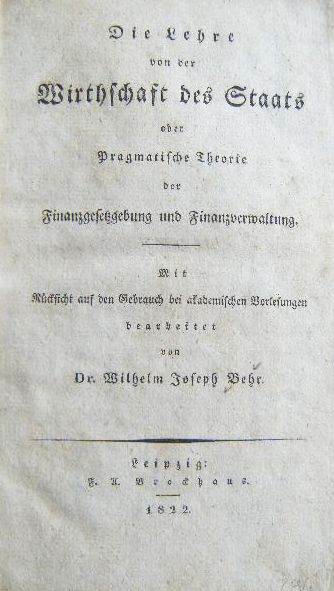 |
First (only) edition. The author treats the economic aspects of statecraft, in particular the legislation and
administration of public finance. Behr was professor of constitutional law at the University of Würzburg.
Popular for his liberal views he was elected first mayor of Würzburg in 1821. After he had called for the
further development of the constitution, and for that was honored by the people carrying him on their shoulders
with the cry ‘He shall be our king', he was removed by King Ludwig of Bavaria and sentenced for high treason
and lèse-majesté in 1832.
Best edition of the ‘first modern attempt to
create a complete system of political science '
 | BODIN, Jean
(1530-1596)
De republica libri sex, latine ab autore redditi, multo quam antea locupletiores.
Lugduni, et venundantur Parisiis, apud Jacobum Du-Puys [Lyon and Paris, Dupuys] 1586.
Folio (35 x 22,5 cm). [VIII],779,[61]p. With printer's vignette on title, coat of arms on verso
and several head- and tail-pieces and decorated initials. Contemp. blind-tooled calf, little rubbed, back expertly
repaired, red edges. Small brown stain in upper left corner, far from printed surface, disappearing halfway.
(#23549)
€ 4500 | 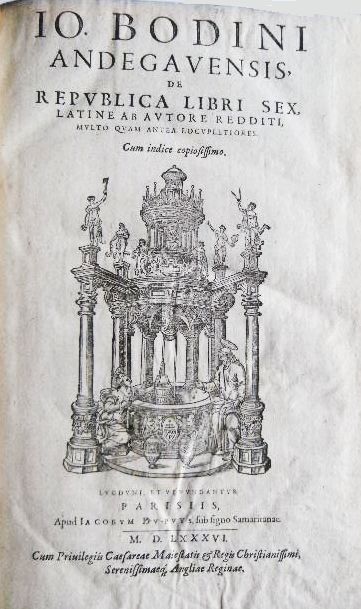 |
First Latin edition, first issue. This Latin edition was translated by Bodin himself. For the translation he
made numerous improvements and additions and it is therefore considered the standard edition. The first edition
appeared in French in 1576 and was many times reprinted until the beginning of the seventeenth century, and
translated into German, English, Italian and Spanish.
‘The Six books of the republic had an immense influence all over Europe. It is, in effect, the first
modern attempt to create a complete system of political science. Its basis was the Politics of Aristotle,
and it was through Bodin that Aristotle's work came to exercise the influence on modern political thinking which
has made him the father of modern democracy. Bodin was not content merely to reproduce his master, however;
he added considerably from his own experience. Although like most sixteenth-century writers he approved of
absolute government, he demanded its control by constitutional laws, in which respect he foreshadowed the
development during the seventeenth century of the idea of the social contract. Thus Bodin was the first to set out
clearly the argument round which most political discussion centred in the seventeenth and eighteenth centuries,
that law is merely an expression of the sovereign will, but that where this reposes in an absolute monarch, it must
be mitigated by a customary or natural law. When the lawgiver's law becomes unjust, it ceases to be valid and
must be resisted.'
First provenance: Thomas Foley, with his armorial bookplate to verso of title ‘Thomas Foley of Great
Witley Court in the County of Worcester Esqr.', and identical but smaller bookplate with only ‘Foley' to front
paste-down. Probably the ironmaster and Member of Parliament Thomas Foley (1616-1677).
Second provenance: Inscribed on front free endpaper: ‘Herman Heller/ with warm regards/ Harold J.Laski'.
Herman Heller (1891-1933), German legal scholar who went into exile in 1933. Harold Joseph Laski
(1893-1950), English political theorist and economist. Below the inscription two illegible lines.
*R.Crahay, M.T.Isaac & M.T.Lenger, Bibliographie critique des éditions anciennes de Jean
Bodin L1a. Printing and the mind of man 94. En français dans le texte 68.
BURCKHARDT, Johann Ludwig (1784-1817)
Voyages en Arabie, contenant la description des parties du Hedjaz, regardées comme
sacrées par les Musulmans, suivis de notes sur les Bédouins et d'un essai sur l'histoire des
Wahhabites. Traduits de l'Anglais par J.B.B. Eyriès.
Paris, Arthus Bertrand 1835.
3 volumes. [IV],XXXII,402,[1]; [IV],472; [IV],352,19,8p. With folding map as frontispiece
and 3 folding plans to volume 1 and folding plan to volume 2. Contemp. half calf, backs with gilt labels, marbled
sides, yellow edges, decorated endpapers. Name on half-titles. Fine set. (#12196)
€ 1750
First French edition. Originally published in 1829 in English as Travels in Arabia, comprehending an
account of those territories in Hedjaz which the Mohammedans regard as sacred. This is followed by a
translation of the author's Notes on the Bedouins and Wahabys, collected during his travels in the East,
published in 1830.
|    |
[CANCRIN, Georg von (1774-1845)]
Die Oekonomie der menschlichen Gesellschaften und das Finanzwesen. Von einem ehemaligen
Finanzminister.
Stuttgart, E.Schweizerbart'sche Verlagshandlung 1845.
XIV,346p. Contemp. decorated cloth, gilt back with label, marbled edges, (#29010)
€ 350  |
First (only) edition. The last book of the author, a German-born economist in Russian service. Cancrin
followed his father to Russia in 1796 and, having attracted attention by his book on military economy (Ueber
die Militairökonomie im Frieden und Krieg, und ihr Wechselverhältniss zu den Operationen, 1820),
was appointed intendant-general of the army. In 1828 he became Russia's minister of finance, a position he held
until 1844, and reformed the fiscal and monetary system. 'By his financial management he increased the revenue,
and raised the credit of the empire, previously on the verge of bankruptcy ... He represented a reaction against
Adam Smith from the point of view of a man of the world who had to conduct the economic practice of a country
much less advanced than England, in fact, as he himself calls it, 'infra-European.'
*Kress C.6556. Humpert 12111. Pagrave I,p.210.
|  |
[Coinage]
Report from the Royal Commission on international coinage; together with the minutes of evidence
and appendix. Presented to both Houses of Parliament by Command of Her Majesty.
London, printed by George Edward Eyre and William Spottiswoode 1868.
Folio (33 x 21 cm). XXII,[2],372p. Orig. printed blue wrappers. (#39518)
€ 350 |  |
First edition. The Royal Commission on international coinage was 'appointed to inquire into and
report on the proceedings of the International Monetary Conference', held in Paris in 1867. The chief
recommendation of that conference was the adoption of a single gold standard. The Commission was presided by
Viscount Halifax and counted among its members Thomas Baring, Mountifort Longfield and John Lubbock.
Among its witnesses were Leone Levi, William Stanley Jevons (p.95-103), Walter Bagehot, G.J.Goschen and
John Bowring.
[COURT, Johan de la (1622-1660)]
Politike discoursen, handelende in ses onderscheide boeken, van steeden, landen, oorlogen, kerken,
regeeringen, en zeeden, beschreeven door D. C.
Tot Leyden, by Pieter Hackius in ‘t jaar 1662.
4to. [XIV],516p. With a fine engraved title by P.Philippe and numerous decorated initials.
Contemp. full calf, richly gilt decorated, gilt edges, hinges partly cracked but both sides firmly holding,
spine-ends little damaged. (#16041)
€ 900 |  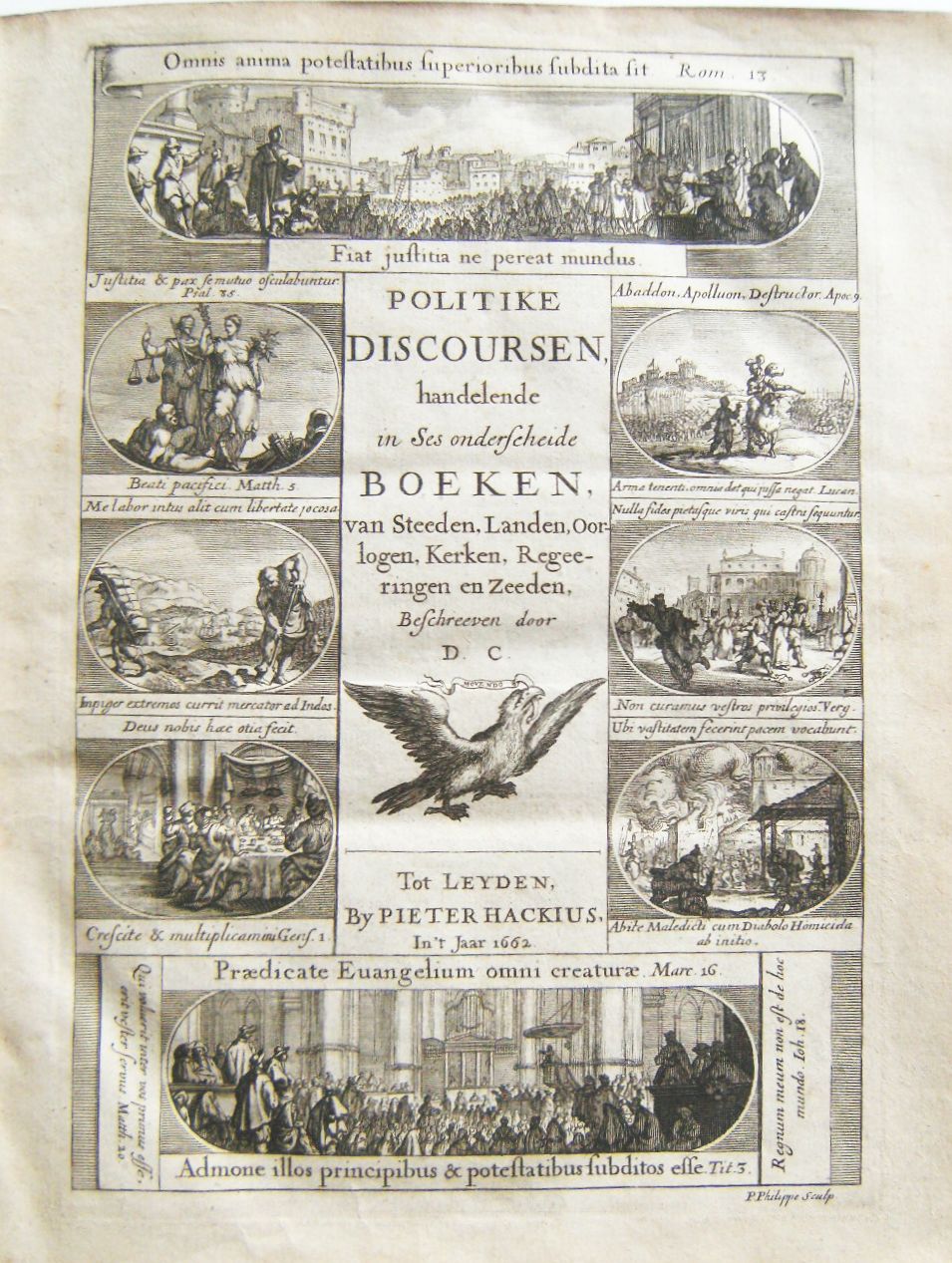 |
First edition, quite rare, and the only 4to edition. A second edition in 8vo appeared the same year and a
third edition in 12mo the next year. Though often attributed to his better known brother Pieter, probably because
it appeared two years after Johan's death, now generally attributed to Johan. It is often praised as the most
important work that came from the brothers, more than Pieter's better known Interest van Holland of
philosophical nature, with extensive references to other political theorists. It is remembered as a pinnacle of the
theory of the superiority of the republican form of government.
*Wildenberg 1061. Van de Klashorst 233.
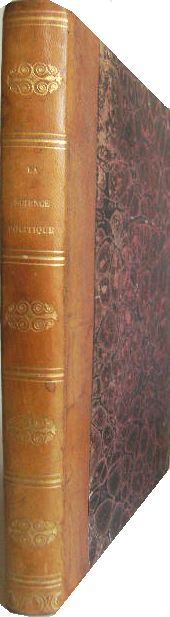 | COURTET DE L'ISLE, Victor (1813-1867)
La science politique fondée sur la science de l'homme, ou étude des races humaines
sous le rapport philosophique, historique et social.
Paris, Arthus Bertrand 1838.
Large 8vo. [IV],XV,[1],397,[3]p. Contemp. half calf, marbled boards and endpapers, gilt back.
Vague damp staining of upper inner corner. On the title ‘ex dono auctoris', and another inscription on the
half-title. (#28280)
€ 600 | 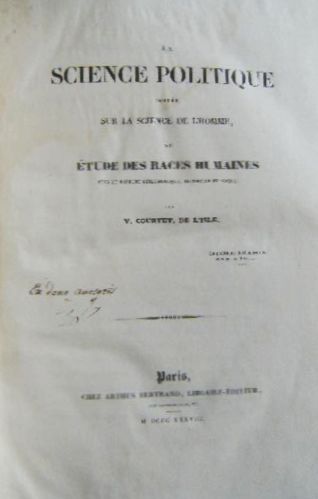 |
First (only) edition. An early work from the realms of anthropology and sociology of Saint-Simonian
inspiration. The author proposes an anthropological refoundation of historical and political science, thus further
developing the theories of the French physiologist and anthropologist William Frédéric Edwards.
It preceded Gobineau's Essai sur l'inégalité des races humaines 15 years and the work is
said to have been amply used by that author. Rare.
Challenging the monopoly of the slave trade of
the West India CompanyCoymans, Isaac. -
Brieven, confessie; mitsgaders advisen van verscheyden rechtsgeleerden in de saeck van Isaac
Coymans gegeven; als mede de sententie daer op gevolgt.
Gedruckt tot Rotterdam, voor Dirck Iansz. [1662].
4to. 75p. Uncut in early 20th century plain boards. (#33474)
€ 1250 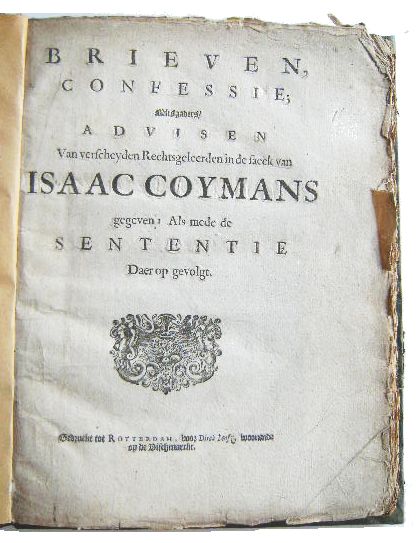 |
First (only) edition. A rare volume on the case of an Amsterdam merchant challenging the monopoly of the
slave trade of the West India Company. Isaac Coymans (also written as Coeymans, Coeimans or Koeimans) was
born in the Southern Netherlands and in 1638 became a bookkeeper and merchant in the service of the West
India Company on the coast of Guinea. He returned to Holland in 1649 to start a slave business on his own
account.
After the discovery of secret correspondence with Joost Kramer, commander of the Danish African
Company in Fort Cabo Cors, Coymans was accused of having incited Kramer against the Company. Coymans
wrote Kramer that the Company planned an attack on him and in the second letter seditiously added that he had
heard that the Company planned to murder the head of the 'Swarten' ('Blacks') named 'Jan Klaesz'. He suggested
Kramer to attack Fort Nassau (Elmina, Holland's first stronghold) with the help of the blacks. Coymans was
arrested and sentenced to six years imprisonment, lifelong banishment from the Netherlands and the areas
covered by the charter of the Company, and a fine of 20 thousand carolus guilders and the costs of his trial and
imprisonment.
Isaac's son Balthasar acquired an assiento in 1685, though for a few years only. The sentence at the end of
the present volume was also issued separately.
*Knuttel 8645. Muller 2292. |
CULIN, Stewart (1858-1929)
China in America: a study in the social life of the Chinese in the Eastern cities of the United States.
Philadelphia [pasted label:] London, Kegan Paul, Trench, Trübner 1887.
4to. 16p. With a folding map of the province of Kwantung, reproduced from the ‘Concord
almanac for 1855'. Orig. vellum wrappers printed in red and black. (#25600)
€ 250 | 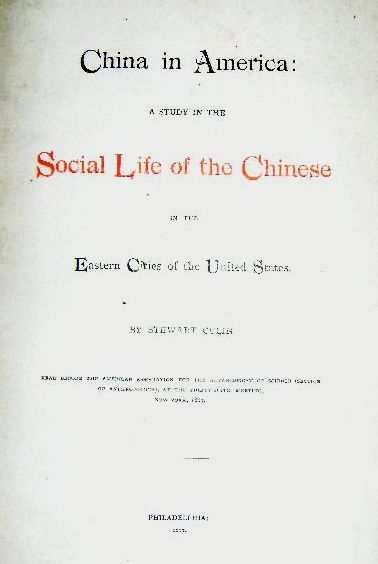 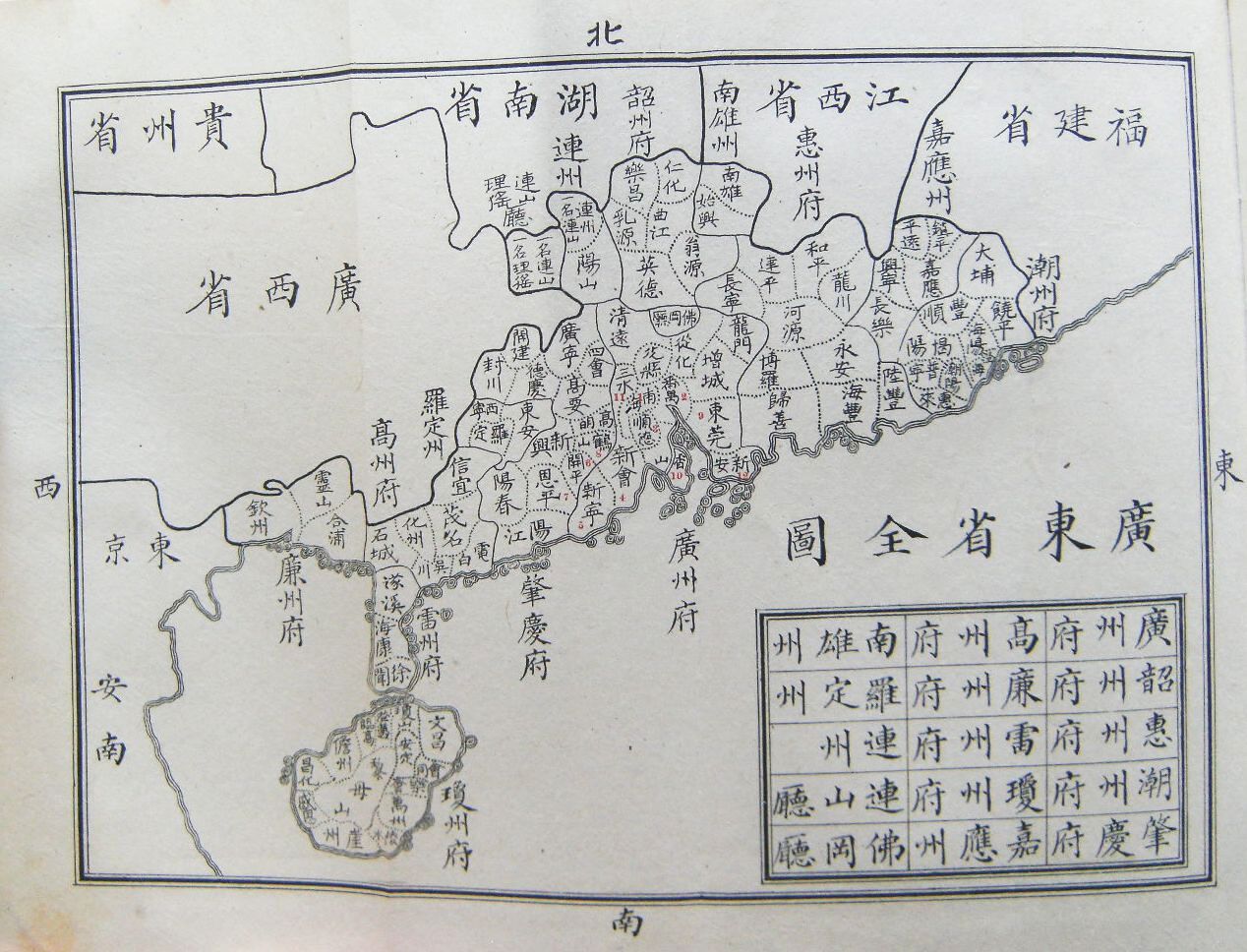 |
First edition. A speech ‘read before the American Association for the Advancement of Science (section of
anthropology), at the thirty-sixth meeting, New Yotk, 1887'.
DAMHOUDER, Joost de (1507-1581)
Practycke in criminele saken, seer nut ende profijtelijck allen souverains, bailjous, borgermeesters,
ende schepenen, &c. Hier is noch by ghevoeght d'ordonnantie op 't stuck van de criminele iustitie in dese
Nederlanden. [Bound with:] Practycke in civile saecken, seer nut, profijtelijck ende noodich allen
schouten, borgermeesteren, schepenen ende andere rechteren.
Rotterdam, Pieter van Waesberge 1650-49.
2 works in 1 volume. 4to. [VIII],264,3-59 (wanting divisional title); [XXXVI],592,[31]p. With
portrait of the author on both titles, 56 woodcut illustrations in the text of the first work and 14 full-page
engravings in the second work. Contemp. overlapping vellum. Fine copy. (#30062)
€ 1500 | 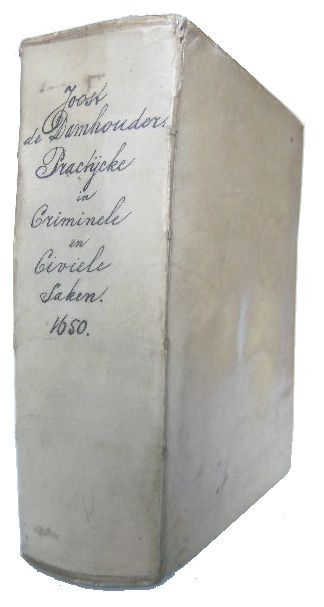 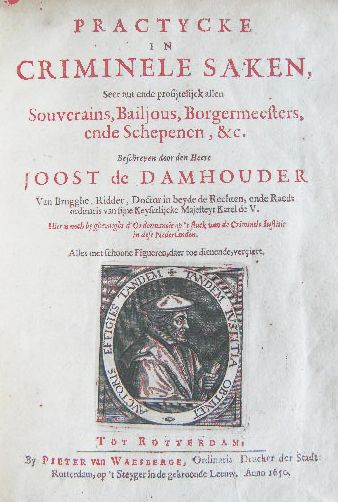 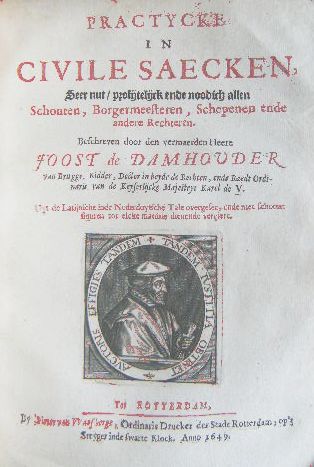 |
A treatise on criminal law, the first work of its kind published outside Italy, that exercised a lasting
influence in Europe. It gives an overview of sixteenth-century legislation, prosecution and punishment of
offences like homicide, blasphemy, mutiny, forgery, burglary, adultery, rape, corruption, adultery, incest,
sodomy, arson, etc. All this is illustrated by fine woodcuts showing scenes from criminal procedure and justice,
including torture. Damhouder asserted that a single indication of guilt was sufficient for torture to be applied to
achieve a confession, though he did recognize that too much torture can produce false confessions. It is highly
interesting not only for the history of legal customs but also for the social conditions connected with these crimes.
An important part is dedicated to witchcraft, according to Damhouder 'a heinous crime that went
unpunished too often because of the ignorance of magistrates'. This is largely based upon Grillandi's Tractatus
de hereticis et sortilegiis. Many authors have pointed out that much of Damhouder's work was based upon, if
not plagiarized, from a manuscript on criminal law by Philips Wielant not published before 1872.
First published in 1554 in Latin and the same year in French and Dutch translation by the author. It was
reprinted many times during the seventeenth century. Here as often bound with the second Dutch edition of the
author's work on civil law, first published in Latin in 1567 and in Dutch in 1626.
*Dekkers p.44,4 and 5.
DU FRESNE DE FRANCHEVILLE, Joseph
(1704-1781)
Histoire de la Compagnie des Indes avec les titres de ses concessions & priviléges
[half-title]. Histoire generale et particuliere des finances, où l'on voit l'origine, l'etablissement, la
perception & la régie de toutes les impositions: dressée sur les pièces autentiques.
Paris, chez De Bure l'aîné 1738.
4to. [XII],660,[1errata]p. With a few woodcut vignettes and decorated initials. Contemp. calf,
back richly gilt, gilt borders and central coat of arms on both sides, marbled endpapers and edges, light wear to
extremities and little worming at spine ends. (#14837)
€ 1250 |  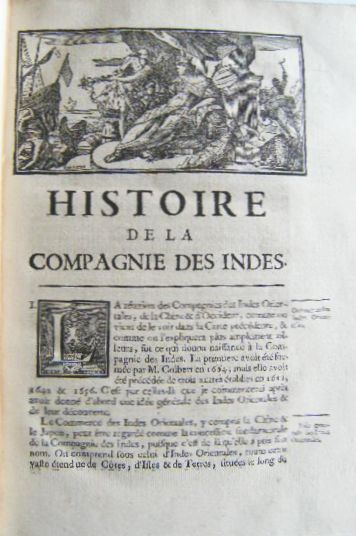 |
First edition. The first part of this volume (p.1-158) is taken by a general history of the French East India
Company, its predecessors in the seventeenth century, the Compagnie des Indes Orientales founded by
Colbert in 1664, remodelled by John Law in 1719 into the Compagnie des Indes. This is followed by
seven parts of documentary evidence: official documents, extracts from private memoirs, etc. These parts treat
successively the commerce with the East Indies, China, Canada, Senegal (with Cape Verde and the African
coast), and Guinea, and separately the coffee trade, and the history of the Company since 1719. The volume ends
with a chronological index of facts and titles and indexes of subjects, geographical names, and persons.
This is the third volume (though not marked as such) that appeared with the quoted general title. The other
two volumes give a detailed account of the tariff of 1664 for exportation (volume 1) and importation (volume 2).
This was the chief work of the author, archeologist, poet and historian. He spent some time at the court of
Frederick II of Prussia and was a member of the Berlin Academy. He was befriended with Voltaire who
published the first edition of his Siècle de Louis XIV under the name of his friend.
*Einaudi 1639. Kress 4380 (volume 3 only). INED 1533. Stourm p.38. Bourgeois & André 6031
('of capital importance'). Sabin 21147 (volume 3 only).
The first German socialist GALL, Ludwig (1791-1863)
Was könnte helfen? Immerwährende Getraidelagerung, um jeder Noth des Mangels und des
Ueberflusses auf immer zu begegnen, und Credit-Scheine, durch die Getraidevorräthe verbürgt, um
der Alleinherrschaft des Geldes ein Ende zu machen.
Trier, bei F.A.Gall 1825.
VIII,180p. With 8 lithograph plates and 8 forms on 2 large folding leaves. Orig. printed blue
wrappers. Foxing mostly limited to first and last leaves and margins. Unidentified inscription to upper wrapper,
modern bookplate to verso. Tiny hole in title affecting one character of the first line. The title on the upper
wrapper is different: Papiergeld durch Getraidevorräthe verbürgt, ein schnelles, vielleicht das
einzige Mittel, Deutschlands gesunkenen Wohlstand zu heben und fest zu begründen, und jeder Noth des
Mangels und des Ueberflüsses auf immer zu begegnen. (#31883)
€ 4500 |  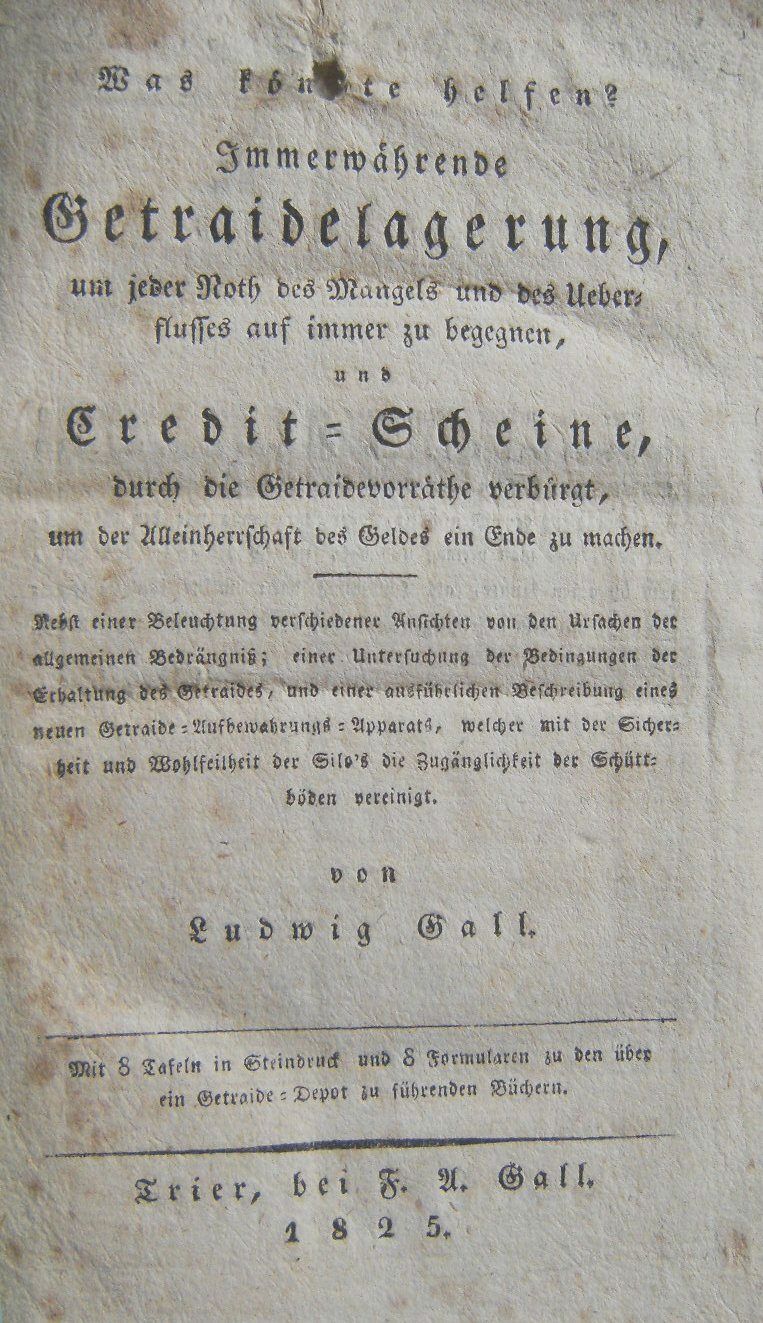 |
First (only) edition, extremely scarce, in particular in the printed wrappers. Ludwig Gall has been called the
first German socialist for his present plea for a collectivist economy What could help. In it, he declared
that labour was the source of all wealth and that millions owned nothing but their power to work. It also states:
'The privileged, moneyed class and the labouring classes, sharply divided as they are by diametrically opposing
interests, are in sharp conflict. As the position of the former improves, so does that of the latter worsen, become
more wretched and distressed.‘
‘In an 1825 pamphlet, Was könnte helfen?, he showed that bourgeois society could not fully satisfy
the basic needs of humankind. According to him, labor power was exploited by money. The impoverishment of
workers was accompanied by the enrichment of the wealthy, which accentuated class antagonisms. Ludwig Gall,
inspired by Fourier, advocated the creation of national workshops that would allow the establishment of a
collectivist economy; in these workshops, workers would receive higher wages, because there would no longer be
a need to ensure the remuneration of capital.' (Le Maitron)
Gall did not embrace the utopian socialists fully, though he had read them and was influenced by a.o.
Robert Owen. He neither supported revolutionary action or overturning private property or capital, but believed
that change should come via political reform and state intervention. He proposed large-scale state-financed public
works to fight unemployment and stimulate economic activity, thus (according to some) foreshadowings
Keynesian demand policy.
After holding various positions, Ludwig Gall came to Trier in 1815 and was appointed secretary of the
newly formed district government. He was shocked by the miserable conditions of the working people and the
factory children. He tried to implement improvements, but due to a lack of government cooperation, he decided
to leave government service and emigrated to America to make preparations for an emigration from the Rhine
Province. He returned to Trier in 1820 and published a book about his experiences Meine Auswanderung
nach den Vereinigten-Staaten in Nord-Amerika. After his return to Germany he worked in Koblenz on,
among other things, improvements for viticulture. For this purpose, he developed the controversial method of
‘wet sugaring'. But he also remained concerned about the fate of the poor population and published his ideas
about it in the present work.
Very rare, in 50 years of bookselling focusing on socialist literature we never came across a copy of this.
*Goldsmiths'-Kress 24479.7. Stammhammer II,p.124,7. Humpert 6870, 9517 and 11307.
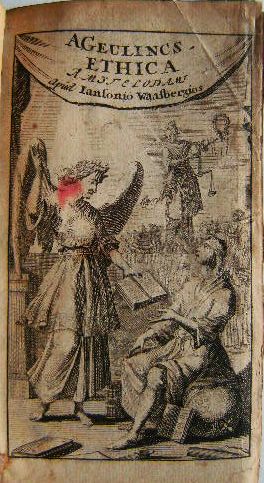
GEULINCX, Arnold (1624-1669)
Gnothi seauton [in Greek type], sive ethica, post tristia auctoris fata omnibus suis partibus in lucem
edita, & tam seculi hujus, quam Atheorum quorundam philosophorum impietati, scelestisque moribus, quanquam
specioso ut plurimum virtutis praetextu larvatis, opposita, per Philarethum. Cui accessit clariss. Cornelii
Bontekoe eruditissimus & utilissimus libellus de Passionibus animae, cum gemina serie rerum, quae utrobique
tractantur, per Joh. Flenderum ... Editio ultima, ab eodem à mendis amplius centum
accuratissimè emendata. [ Second part with own title page without imprint:] Cornelii
BONTEKOE, Tractatus ethico-physicus de animi & corporis passionibus ...
Amstelodami [Amsterdam], Janssonio-Waesbergios 1709.
2 parts in 1 volume. 12mo. [XXXII],437,[1 blank], [VIII],110,[9]p. With engraved frontispiece.
Contemp. overlapping vellum. Frontispiece with folds, repair to outer margin and faint offsetting from red
lacquer to front free endpaper, tiny repair to printed title. (#32746)
€ 1000
Third edition. First published posthumously by Bontekoe in 1675 with a second edition in 1696. Geulincx
was educated in Louvain and there appointed professor of philosophy in 1646, and moved to Leiden in 1658.
Geulincx developed an occasionalist philosophy out of Cartesian principles, and many contemporary and modern
scholars have pointed out the similarities between his and Spinoza's ethics. Even in one of the laudatory
poems in the first edition of this - published two years before Spinoza's Ethica - both authors are
compared: ‘Frustra hic Spinosae quaeras molimina mentis'.
|    |
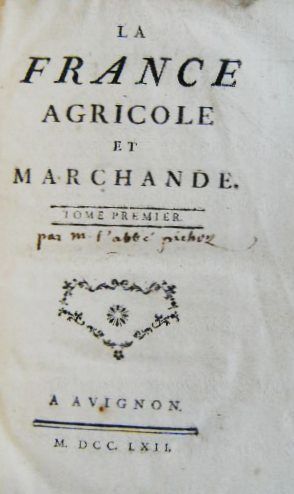
[GOYON DE LA PLOMBANIE, Henri de (1737-1808)]
La France agricole et marchande.
A Avignon 1762.
2 volumes. XII475; XI,[1],616p. With 11 folding plates, including 2 maps, 1 coloured.
Contemp. full calf, gilt backs with red and green labels, triple line borders on all sides, marbled endpapers and
edges, hinges show beginning of cracking but holding firmly. On the title of volume 1 erroneously 'par m
l'abbé pichou‘. (#31847)
€ 750  |
First (only) edition. A wide-ranging work on economic, agricultural, political and social progress, with
emphasis on the means to increase agricultural production. The anonymous author, about whom little seems
known, predicts a complete change in the morality of the population that will enable a new utopian society, the
ideal world. He predicts a huge increase in production through improved technology, fiscal and financial reforms,
industrialization, etc. This will result in a huge growth of urban population. He compares society to a machine,
the different individuals together form a well-organized social entity. The author gives detailed descriptions of
agricultural and other machinery.
*INED 2116. Not in Kress, Goldsmiths' or Einaudi.
|  |
HAYEK, Friedrich August von
(1899-1992)
Geldtheorie und Konjunkturtheorie.
Wien-Leipzig, Hölder-Pichler-Tempsky 1929.
XII,147,[2]p. Orig. printed stiff wrappers, minor surface wear to lower inner corner (from a
removed label?). Small nice bookplate of Harald Jürgensen to inside upper wrapper. (Beiträge zur
Konjunkturforschung 1. Herausgegeben vom Oesterreichischen Institut für Konjunkturforschung)
(#16281)
€ 4500 | 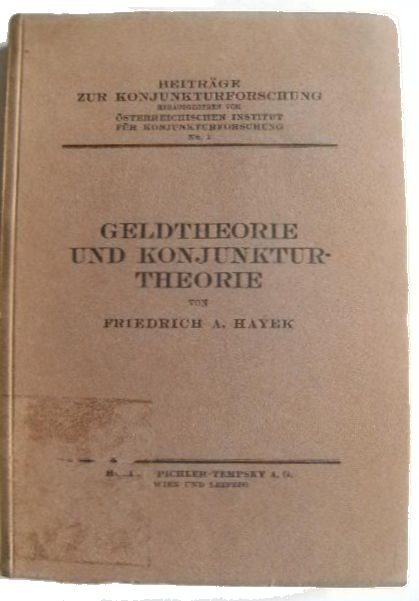 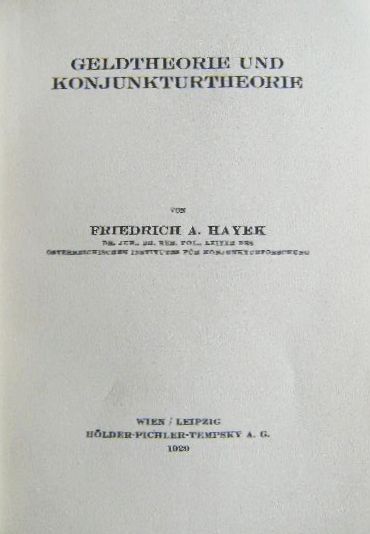  |
Presentation copy, inscribed on first blank: ‘Herrn Geheimrat Prof. Dr. Adolf Weber/ in
aufrichtiger Verehrung überreicht/ vom Verfasser/ Wien, am 20.II.1929'.
First edition. Hayek's first separate publication and the first of a series of books on economic theory issued
by the Austrian Institute for Business Cycle Research, founded in 1927 by Ludwig von Mises and with Hayek as
its first director.
Harald Jürgensen (1924-2008) was a German economist, professor of economics in Hamburg from
1960 to 1990, and founder of the Institut für Europäische Wirtschaftspolitik.
Adolf Weber (1876-1963) was a German economist, associated with the Austrian School of economics,
and professor at the University of Munich from 1921 to 1948.
*Gray B-1.
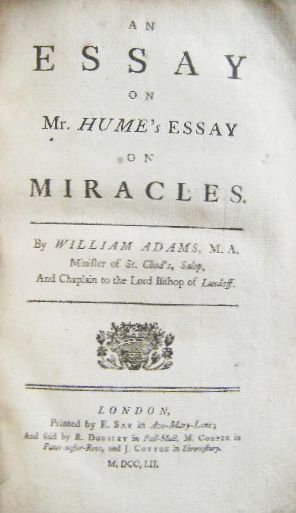
Hume, David. - ADAMS, William (1706-1789)
An essay on Mr. Hume's Essay on miracles.
London, printed by E.Say in Ave-Mary-Lane; and sold by R.Dodsley in Pall-Mall, M.Cooper in
Pater-noster-Row, and J.Cotton in Shrewsbury 1752.
[IV],134p. Nineteenth-century calf-backed marbled boards. Half-title and last blank little
stained. (#15216)
€ 1000  |
First edition. One of the first answers to Hume. ‘[This] was long considered as one of the ablest answers
that appeared to David Hume's writings, and was distinguished for acuteness, elegance, and urbanity of style.
Hume, whom he once met in London, acknowledged that he had treated him much better than he deserved.'
Hume's essay Of miracles had appeared in 1748 as the tenth of his Philosophical essays concerning
human understanding.
‘Adams says that the divine power supplies an adequate cause for the production of the alleged effects,
which are therefore credible upon sufficient evidence.'
This is the principal book of the author. William Adams was educated at Pembroke College, Oxford, where
in 1775 he became Fellow and Master. He was a lifelong friend of Samuel Johnson.
This was reprinted in 1754 with a slightly different title, and again in 1776, and even translated into Italian.
*Chuo p.242. Jessop p. 54.
|  |
'It is the principle here that it is not essential
that the people are in large numbers, but that it is of capital importance that they are happy‘ [JAUNEZ-SPONVILLE, Pierre Ignace
(1750-1805)] & Nicolas BUGNET
(1749-1822)
La philosophie du Ruvarebohni, pays dont la découverte semble d'un grand
intérêt pour l'homme, ou récit dialogué des moyens par lequels les Ruvareheuxis,
habitans de ce pays, ont été conduits au vrai et solide bonheur; par feu P. J. J.S** et Nicolas
Bugnet. [As usual followed by:] Nicolas BUGNET, Catéchisme social ou exposition
familière des principes posés par feu M. P. I. J.** S.**, dans un ouvrage inédit, auquel il
est donné pour titre: Recherches sur la nature des êtres sensibles.
[Paris], de l'imprimerie de Le Normant [1809]-08.
3 volumes in 2. 12mo. VIII,9-283; 222,[5], 6,11-72,[4 errata],4[publ.cat.]. Contemp. half calf,
backs richly gilt decorated, marbled sides and edges. Bookplate (‘F. Lachèvre') to front pastedown of
first volume with some annotations. (#32367)
€ 4500 | 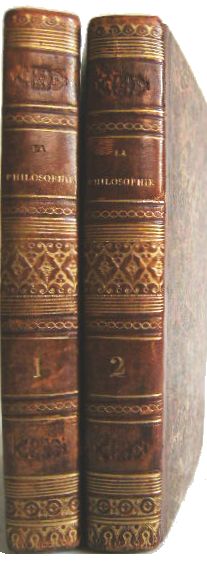 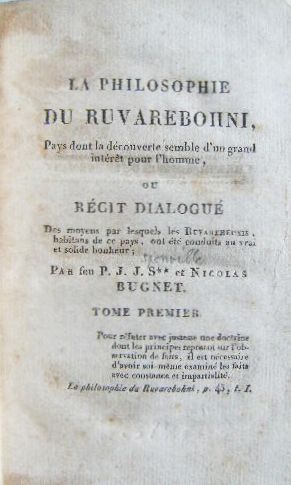 |
First edition. Very rare since most copies were seized and destroyed by the police, with only two copies
located in WorldCat.
The most famous utopia of the Napoleontic era. It is however not only an imaginary voyage but also a
political attack against France (‘Narcef'), the French (‘Inarçafs') and Napoleon (‘Ponelano'). It is written
in the form of a dialogue between an inhabitant of an unidentified country named Ruvarebohni (an anagram of
‘Vrai bonheur') and a foreign visitor. It contains numerous ideas that foreshadowed those of the utopian socialists
of the following decades.
The second work, Bugnet's Catéchisme, occupies the second half of the second volume and
has an own title-page and pagination. The publisher's name appears only on the verso of the title of the first work.
The second work has the publisher's name on title, it had been published separately already in 1808. The next
year Bugnet finished the whole work after the manuscripts left by his close friend Jaunez-Sponville.
A new edition appeared 1881 edited by Carle de Rash (pseud. for Charles Read) ‘d'après un
exemplaire échappé au pilon de la Haute Police Impériale'. The absence of the two leaves
(p.7-10) from the second work is correct and explained in the errata.
*INED 2353. Maitron II,p.375. WorldCat locates copies in the BnF and BL only.
Kant, Immanuel. - RINK, Friedrich Theodor (
1770-1811)
Ansichten aus Immanuel Kant's Leben
Königsberg, bey Göbbels und Unzer 1805.
Small 8vo. 150p. Modern vellum, back with red label. Some brown spots, mostly towards the
end. (#25765)
€ 600 |   |
First (only) edition. An early biography of Kant, published a year after his death. Rink was a protestant
theologian and philosopher, since 1794 professor of theology at the University of Königsberg. He had attended
some of Kant's lectures and later as his colleague became a good friend of him. On Kant's request he published
the latter's Lectures on Physical Geograhy in 1802.
 |
KELSEN, Hans (1881-1973)
Reine Rechtslehre. Einleitung in die rechtswissenschaftliche Problematik.
Leipzig und Wien, Franz Deuticke 1934.
XIV,[2],236p. Orig. printed wrappers, back discolored, vague fold in upper wrapper. (#22495)
€ 500 |
First edition. Kelsen's main statement of his theory of law that became one of the major books on law of the
twentieth century. It was written while in Swiss exile and immediately translated into English as Introduction
to the problems of legal theory by Bonnie Litschewski Paulson and Stanley L.Paulson. A much expanded
second edition, effectively a different book, appeared 1960.
KNOBLAUCH, Carl [Karl] von (1756-1794)
Politisch-philosophische Gespräche. Erster Theil [all published].
Berlin, in der Vossischen Buchhandlung 1792.
Small 8vo. 224p. Uncut, wide-margined copy in old worn grey wrappers. (#24457)
€ 950 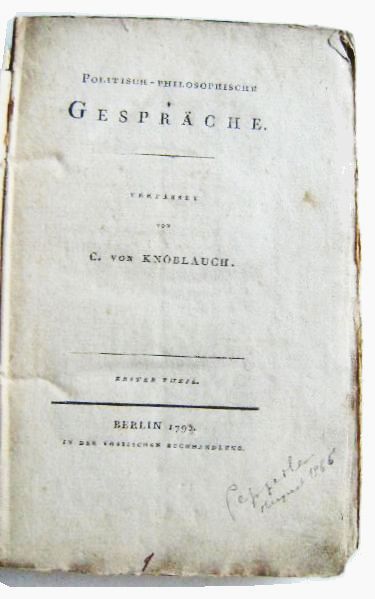 |
First separate edition, very rare. Knoblauch was a lawyer and philosopher with strong rationalist and
materialist views, inspired by Spinoza and the French materialist writers. He studied law and philosophy in
Giessen and Göttingen and entered the service of the House of Nassau-Dillenburg.
Knoblauch was the author of several, mostly anonymously published, anti-religious works. ‘He was one of
the most radical German materialists of the eighteenth century, who mercilessly denounced superstition and
religion. He was a quarrelsome atheist and an unyielding opponent of the church. His works are reminiscent of
the combative anti-religious publications of the French materialists. Knoblauch considered it his mission to shed
light on the history of the origins of superstition and miracles.'
The present work, which orginally appeared in the Teutsche Merkur of 1789-90 seems his most
important. In it, Knoblauch combines his legal and philosophical thoughts with economic concepts derived from
mercantilist and physiocratic principles.
*Spinoza-Bibliographie 1945.
|
A precursor of John Law LA JONCHERE, Etienne Lecuyer de
(1690-1740?)
Système d'un nouveau gouvernement en France. Seconde edition.
A Amsterdam, chez François le Bon 1720.
4 volumes in 1. 12mo (15,5 x 9 cm). [II],30,[2],96; [II],156; [II],192; [II],200,[4]p. With 4
folding tables (small tear in 2 tables). Contemp. calf, gilt back with red label, few old neat repairs, little rubbed.
A few spots and some light staining, old name on title. (#23187)
€ 3750 | 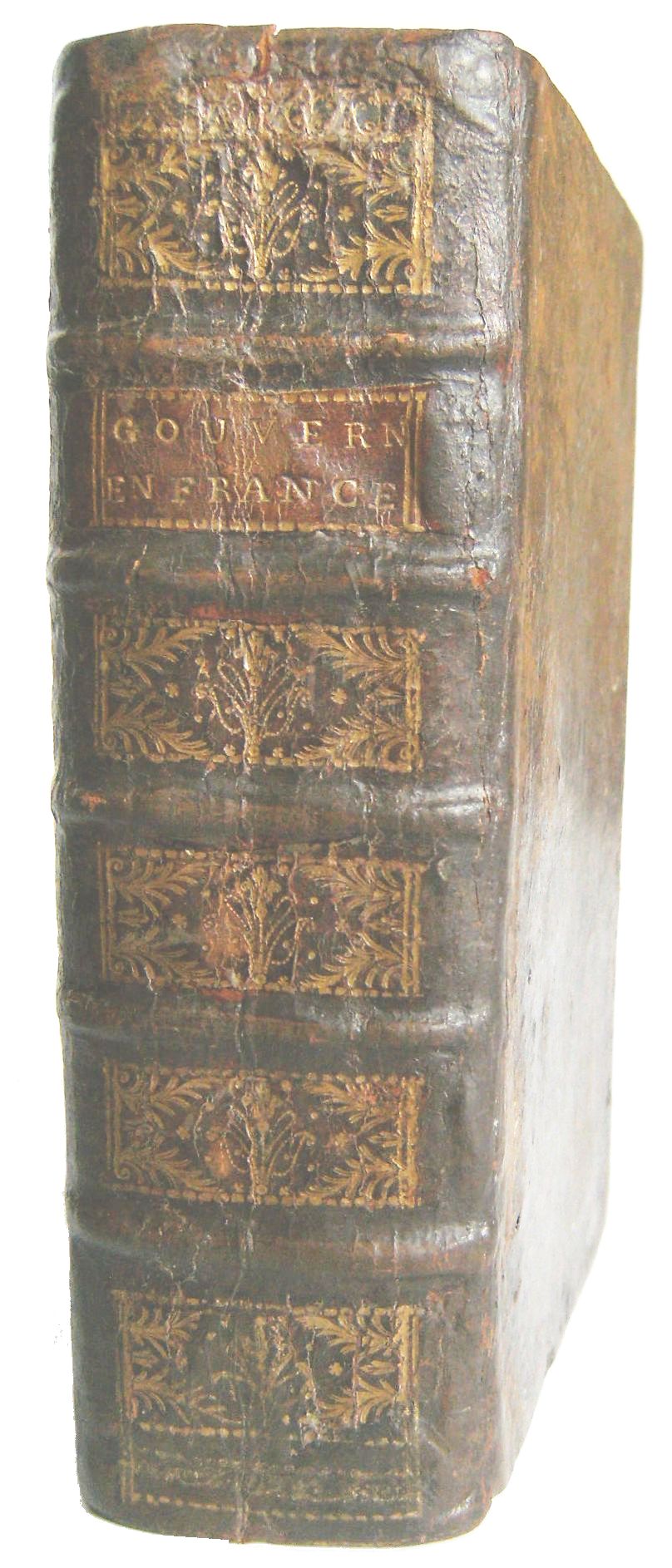 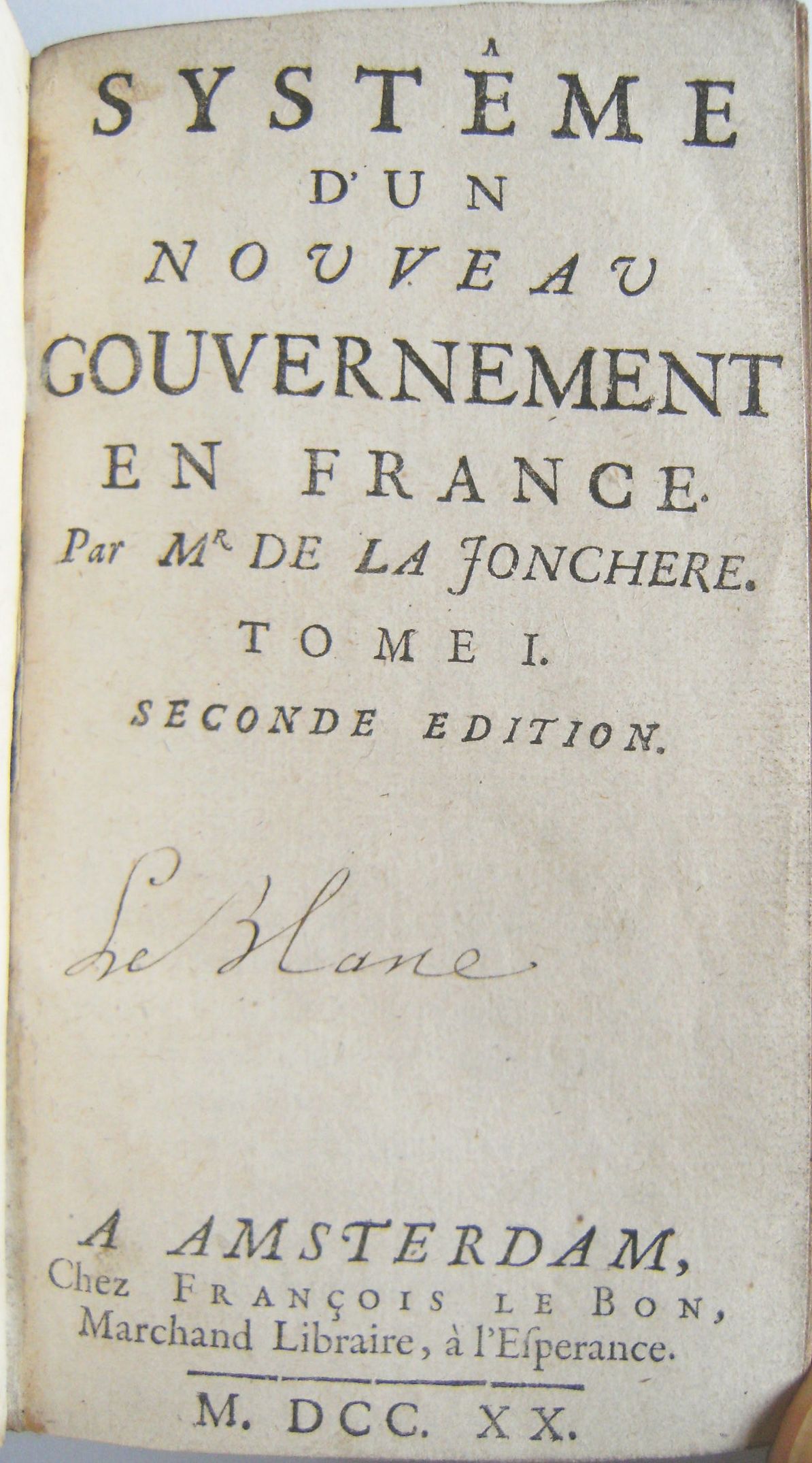 |
A notoriously rare proposal for financial and governmental reforms similar to the scheme of John Law. The
extreme rarity of this book has been explained by Law's eagerness to destroy as many copies as he could find to
hide the fact that much of his own ideas were contained in this book.
‘[La Jonchère] advocates one sole tax, to be paid without privilege or exemption, by all Frenchmen
without distinction, to consist of a percentage collected in money or in kind, on the general produce of the
ground, mines, quarries, etc., by a ‘Compagnie du Commerce', to be formed for the purpose. This company was
to have the monopoly of foreign trade, its shares being given as reimbursement of the price of all the offices sold
by the king's predecessors and of the capital of the rents due to towns or individuals. The corn collected by the
company was also to be entrusted with the recoinage and ‘diminuations' of the metallic currency, which were to
bring it down to what La Jonchère calls ‘its intrinsic value'.'
The mention of ‘Seconde edition' is probably fictious. WorldCat does not locate any copy printed before
1720. The 1970 EDHIS reprint also from this ‘second' edition. The name and place of the publisher are probably
fictious as well.
*INED 2517. Not in Kress, Goldsmiths', Einaudi or Mattioli. Palgrave I,p.537.
Law, John.
Collection of 37 legal documents on the système of John Law, the Compagnie des
Indes and the Banque générale, many dealing with the decrease in the value of the
paper money issued by the Bank.
Most, if not all, were published at Grenoble by Giroud between 1716 and 1722.
Alle are in 4to, most have woodcut vignettes and/or decorated initials. They are untrimmed and
disbound, with a few exceptions bright and clean. Some have a printed number at head, many others a manuscript
number. (#18049)
€ 2500
 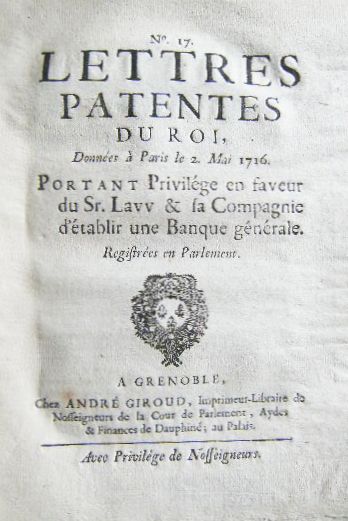 
1. Lettres patentes du Roi, données à Paris le 2. Mai 1716. Portant privilége en
faveur du Sr. Lavv & la Compagnie d'établir une Banque générale. A Grenoble, chez
André Giroud [1716]. 6p.
2. Lettres-patentes du Roi, données à Paris le vingtieme Mai 1716. Contenant
réglement pour la Banque générale accordée au sieur Lavv & à sa
Compagnie. [At end:] Réimprimé à Grenoble, chez André Giroud [1716]. 7p.
3. Edit du Roy, donné à Paris au mois de May 1716. Au sujet des billets payables au
porteur. [At end:] A Grenoble, chez Alexandre Giroud. 10p.
4. Déclaration du Roi, donnée à Paris le 25 de Juillet 1716. Sur les endossemens
des billets de la Banque générale. [At end:] Réimprimé à Grenoble, chez
André Giroud 1766. 3p.
5. Déclaration du Roi, donnée à Paris le 2 Janvier 1717. Au sujet des protêts
des billets & lettres-de-change. Réimprimé a Grenoble, chez André Giroud 1766. 7p.
6. Edit du Roy. Donné à Paris au mois d'Avril 1717. Portant reglement general pour le
commerce des Indes, & de l'Amérique. [No place, no printer, no date.] 21p.
7. Lettres patentes du Roy, données à Paris au mois d'Aout 1717. Portant
établissement d'une Compagnie de Commerce, sous le nom de Compagnie d'Occident. [No place, no
printer, no date.] 30p.
8. Arrest du Conseil d'estat du Roy. Du premier Decembre 1719. Concernant les billets de Banque. [No
place, no printer, no date.] 4p.
9. Arrest du Conseil d'estat du Roy, portant diminution sur les loüis d'or, et sur les ecus. Du 3.
Decembre 1719. A Grenoble, chez Gaspard Giroud 1720. 4p.
10. Arrest du Conseil d'estat du Roy. Du 21. Decembre 1719. Quir ordonne la maniere dont les
païemens doivent être faits, tant à Paris que dans les Provinces. Et qui regle la difference
entre la monnoye de Banque & la monnoye courante. [No place, no printer, no date.] 4p.
11. Arrest du Conseil d'estat du Roy, pour la diminution des espèces & matieres d'or et d'argent, &
qui ordonne que les billets de Banque auront cours dans tous le Royaume. Du 20. Janvier 1720. [No place, no
printer, no date.] 3p.
12. Arrest du Conseil d'estat du Roy, qui donne cours aux anciennes & nouvelles especes à
proportion de neuf cens livres le marc d'or, et de soixante livres le marc d'argent. Du 22. Janvier 1720. [No place,
no printer, no date.] 3p.
13. Arrest du Conseil d'estat du Roy, concernant les monnoyes. Du troisiéme Fevrier1720. [No
place, no printer, no date.] 4p.
14. Declaration du Roy. Donnée à Paris le 4. Fevrier 1720. Portant deffenses de porter des
diamants. A Grenoble, chez Gaspard Giroud [no date]. 8p.
15. Arrest du Conseil d'estat du Roy; du 9. Fevrier 1720. Qui proroge le cours des espèces d'or et
d'argent. [No place, no printer, no date.] 4p.
16. Déclaration du Roy, donnée à Paris le 18. Fevrier 1720. Concernant la vaisselle
& autres ouvrages d'or et d'argent. [At end:] A Grenoble, chés Gaspard Giroud [no date]. 8p.
17. Extrait du registre des délibérations de la Compagnie des Indes; au sujet de la Banque,
& des billets de Banque. [At end:] [No place], de l'imprimerie de la veuve d'André Giroud 1779. 4p.
18. Arrest du Conseil d'estat du Roy, qui regle le prix & le cours des espêces. Du 25. Fevrier 1720.
[No place, no printer, no date.] 4p.
19. Arrest du Conseil d'estat du Roy, concernant les billets de Banque, les actions de la Compagnie des
Indes, le cours des espêces, & le prix des matieres d'or et d'argent. Du cinquiéme Mars 1720. [No
place, no printer, no date.] 4p.
20. Declaration du Roy. Donnée à Paris le 11. Mars 1720. Pour abolir l'usage des especes
d'or au premier May prochaine; & pour indiquer les diminutions sur lesdites especes ... [No place, no printer, no
date.] 8p.
21. Edit du Roi pour la fabrication des Loüis d'argent. Donné à Paris au mois de
Mars 1720. [No place, no printer, no date.] 3p.
22. Arrest du Conseil d'estat du Roy. Pour défendre pendant le cours de la presente année,
l'entrée des espèces & matieres d'or & d'argent dans le Royaume. Du 19. Mars 1720. [No place,
no printer, no date.] 3p.
23. Arrest du Conseil d'état du Roi. Par lequel sa majesté déclare nulles & de nul
effet, les stipulations faites pour paiements en espèces sonnantes. Et ordonne que nonobstant pareilles
stipulations faites & à faire, tous paiements soient faits en billets de Banque. Du 6 Avril 1720. [At end:]
[No place], de l'imprimerie de la veuve d'André Giroud 1779. 3p.
24. Arrest du Conseil d'estat du Roy, du 29e. May 1720. Qui proroge jusqu'au premier Juillet prochain la
diminution indiquée au premier Juin sur les espèces neuves, par la Déclaration du 11.
Mars dernier. Et qui donne cours aux anciennes especes d'or & d'argent à proportion. [No place, no
printer, no date.] 4p.
25. Arrest du Conseil d'estat du Roy, du vingt-uniéme May 1720. Concernant les actions de la
Compagnie des Indes, & les billets de Banque. [No place, no printer, no date.] 8p.
26. Arrest du Conseil de'stat du Roy. Qui revoque celui du 21. May. Concernant les actions de la
Compagnie des Indes, & les billets de Banque. A Grenoble chés Gaspard Giroud [no date]. [II],2p.
27. Arrest du Conseil d'estat du Roy, du premier Juin 1720. Qui permet à toutes personnes d'avoir
en leur possession, & de garder telles sommes en especes qu'elles jugeront à propos. [No place, no
printer, no date.] 3p.
28. Arrest du Conseil d'etat du Roy. Cconcernant les billets de Banque. Du onziéme Juin 1720. [No
place, no printer, no date.] 3p.
29. Arrest du Conseil d'etat du Roi, du 30. Juillet 1720. Portant augmentation des espèces d'or et
d'argent. [No place, no printer, no date.] 4p.
30. Arrest du Conseil d'estat du Roy. Du trente-uniéme Juillet 1720. Portant augmentation es
especes de billon. [No place, no printer, no date.] 3p.
31. Arrest du Conseil d'estat du Roy, concernant le cours des billets de Banque. Du 15. Aout 1720. [No
place, no printer, no date.] 4p.
32. Arrest du Conseil d'estat du Roy, portant reglement pour les billets de Banque, & les actions de la
Compagnie des Indes. Du 15. Septembre 1720. [No place, no printer, no date.] 4p.
33. Edit du Roy, donné à Paris au mois de Septembre 1720. Portant qu'il sera
fabriqué de nouvelles especes d'or et d'argent. [No place, no printer, no date.] 4p.
34. Arrest du Conseil d'estat du Roy, du dixiéme Octobre mil sept vent vingt. Portant suppression
des billets de Banque au premier Novembre prochain. [No place, no printer, no date.] 4p.
35. Declaration du Roy. Donnée à Paris le 21. Janvier 1721. Pour retablir l'usage des
lettres & billets au porteur. A Grenoble, chés Gaspard Giroud [no date]. 8p.
36. Arrest du Conseil d'estat du Roy. Qui ordonne que tous les contracts de rentes, tant perpetuelles, que
viageres ... toutes les actions interessées de la Compagnie des Indes ... ensemble tous les billets de
Banque, seront representez dans deux mois pardevant les commissaires qui seront pour ce nommez, pour
être par eux procedé à la vérification desdits effets. Du 26. Janvier 1721. [No
place, no printer, no date.] 4p.
37. Declaration du Roy. Donnée à Versailles le 9. Aout 1722. Portant retablissement du
prest & droit annuel des offices & charges. [No place, no printer, no date.] 11p.
The best account of the system of John
Law Law, John. - [MARMONT DU
HAUTCHAMP, Barthélemy (1682-c.1760)]
Histoire du système des finances, sous la minorité de Louis XV. Pendant les
années 1719 & 1720. Précedée d'un abregé de la vie du duc Régent, & du
Sr. Law.
La Haye, Pierre de Hondt 1739.
6 volumes in 3. 12mo. LIV,55-204,[II],312; [II],208,[II],286; [XIV],294,[XVIII],246p. With an
engraved plate, 2 folding tables printed on both sides and a seal of the Banque Royale. Contemp. calf, gilt
backs with double labels, marbled sides and endpapers. Fine set. (#12715)
€ 4500 | 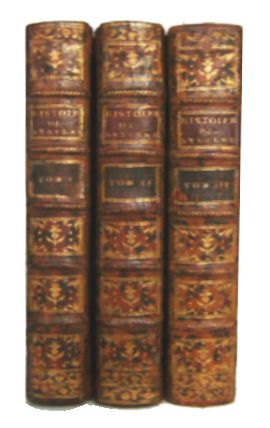 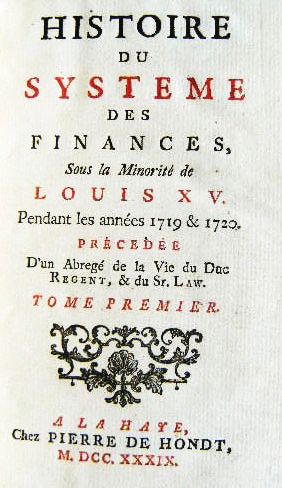 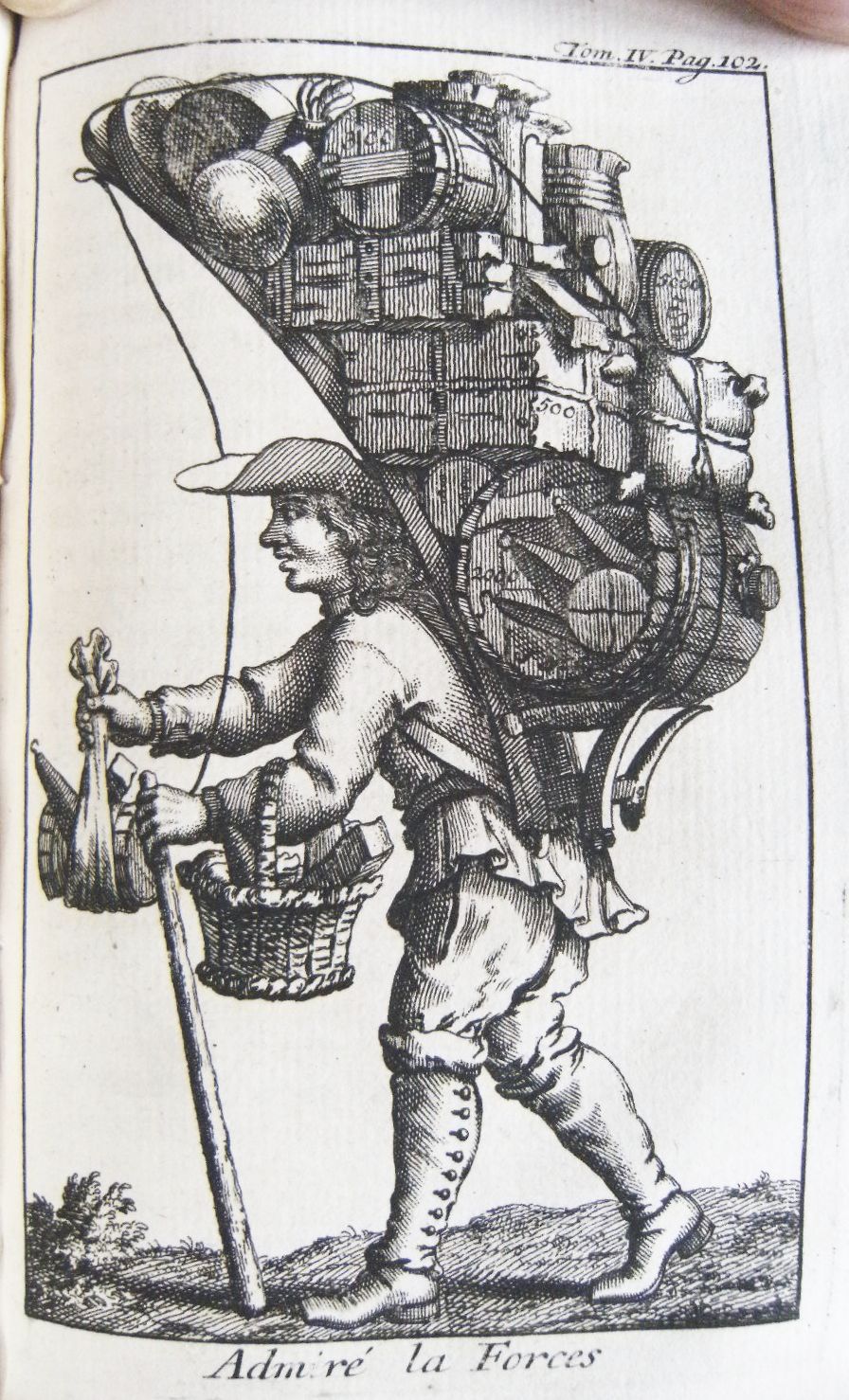 |
First (only) edition. An account of the financial operations of John Law and his Compagnie des
Indes, including a great number of relative memoirs, letters patent, decrees, declarations, etc.
Marmont du Hautchamp had been an admirer of John Law's system and his book is not written without
partiality but has yet been recognized as the best contemporary history of the system and its most precious
source.
John Law's operations began with the foundation in 1716 of the Banque Générale,
soon afterwards renamed Banque Royale. This was followed by the scheme of colonization known as
Mississippi scheme in the Compagnie des Indes which, by absorbing various other chartered
companies, acquired the monopoly on the trade to America, Africa and China. Moreover, the company obtained
the monopoly of tobacco, the control of the mint, the payment of the national debt, and the farm of the taxes.
Within a few years Law's companies thus got almost complete control over France's overseas trade, its currency
and public finances. In 1719 the Compagnie des Indes and the Banque Royale were united, and
the promising outlooks of the new company lead to an unprecedented speculation in its shares. As known the
bubble burst in 1720, cash payments were suspended and Law fled from the country, leaving behind ruined many
of his former supporters.
*Kress 4447. Einaudi 3728. Goldsmiths' 7712. Stourm p.73. Palgrave II,p.576.
MARX, Karl (1818-1883)
Der achtzehnte Brumaire des Louis Bonaparte. Zweite Ausgabe.
Hamburg, Otto Meissner 1869.
VI,98p. Contemp. cloth-backed boards. (#23448)
€ 2500 | 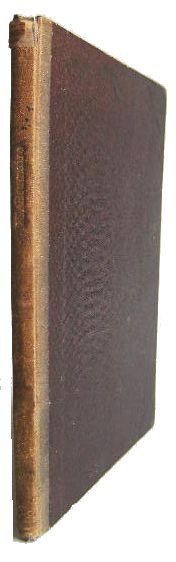 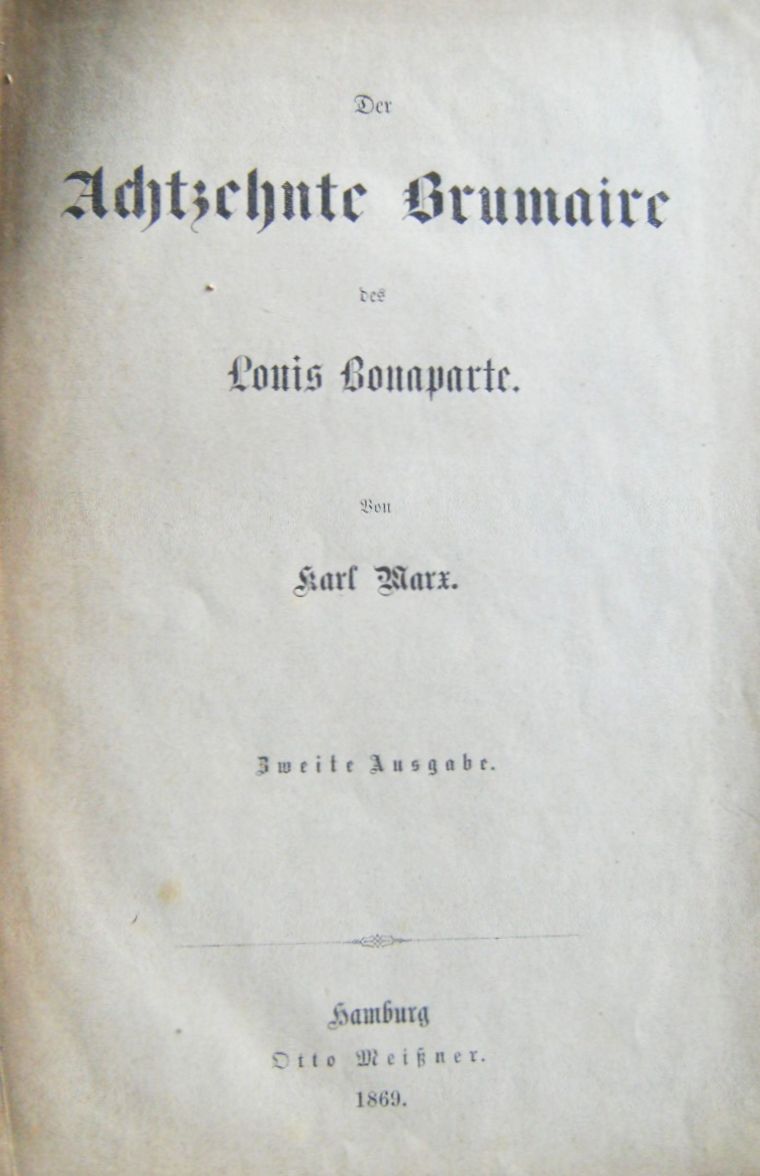 |
First edition in book form, with a new preface by Marx dated 23 June 1869. Originally published with a
preface by J.Weydemeyer in the journal Die Revolution, New York 1852, with a slightly different title
Der 18te Brumaire des Louis Napoleon.
*Erstdrucke p.22. Rubel 215. Draper 267.
 | MARX, Karl (1818-1883)
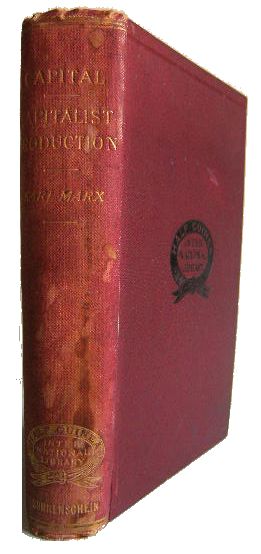
Capital. A critical analysis of capitalist production. Translated from the third German edition, by
Samuel Moore and Edward Aveling and edited by Frederick Engels.
London, Swan Sonnenschein 1896.
XXXII,816p. Orig. red cloth, gilt back, back and rear cover stained, light rubbing to extremities
of the back. Mild foxing to preliminary and last leaves. (#13852)
€ 950 | 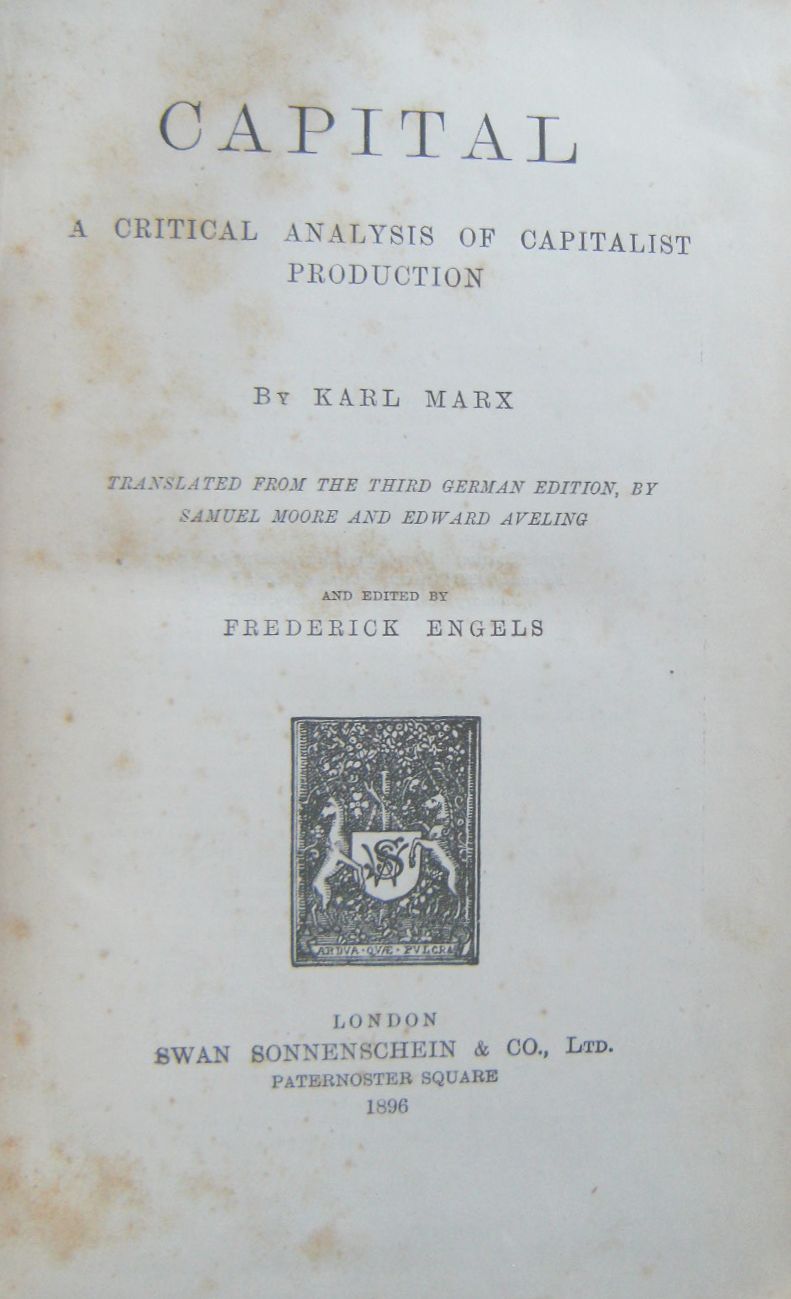 |
Fifth British edition, reprinting the text of the first English edition published by Sonnenschein in two
volumes in 1887. It is also the last nineteenth century edition. Curiously on the verso of the title the first English
edition is dated 1886.
*Erstdrucke p.33. Rubel 633.
[MARX, Karl (1818-1883) &
Friedrich ENGELS (1820-1895) & Paul LAFARGUE
(1842-1911)]
Ein Complot gegen die Internationale Arbeiter-Association. Im Auftrage des Haager Congresses
verfasster Bericht über das Treiben Bakunin's und der Allianz der socialistischen Demokratie. Deutsche
Ausgabe von 'L'alliance de la démocratie socialiste et l'association internationale des travailleurs'.
Uebersetzt von S.Kokosky.
Braunschweig, Druck und Verlag van W.Bracke jr. 1874.
VI,[2],119p. Later boards. (#16776)
€ 3500 |  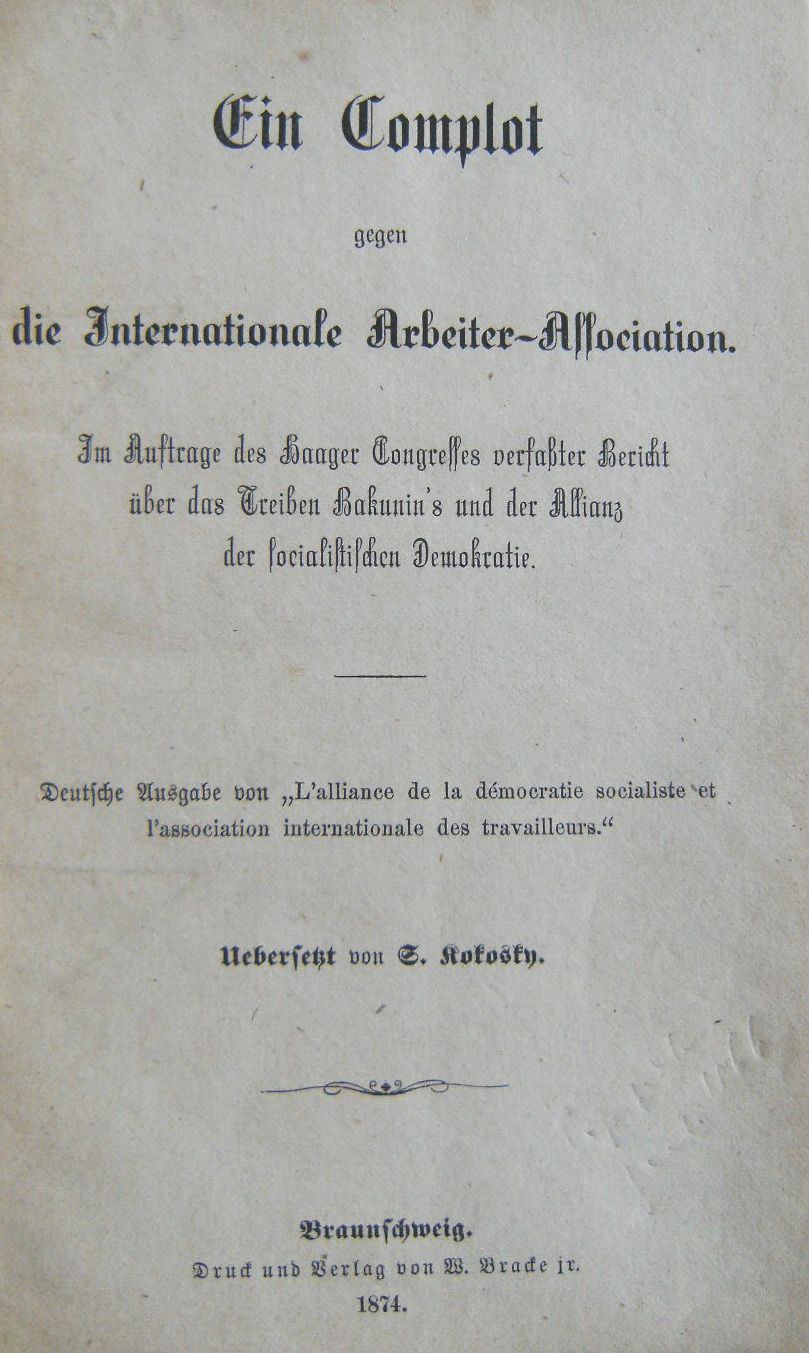 |
First German edition. Originally published in French (with London and Hamburg imprint) the previous
year, by order of the Hague Congress of September 1872 of the International Workingmen's Association. It was
intended as a justification for the exclusion of the anarchist faction ‘Alliance de la démocratie socialiste'
of Bakunin and Guillaume, that, according to Marx, wanted to take over the International. The Hague Congress
marked the break of the First International between anarchism and Marxism within the workers' movement. It
was written by Engels with the help of Paul Lafargue, with a concluding chapter written in cooperation with
Marx, and has appended the text of the 'secret regulations of the Alliance', and some other documents.
*Rubel 726. Répertoire international des sources pour l'étude des mouvements sociaux
aux XIXe et XXe siècles. La Première Internationale II,48. Erstdrucke p.37. Draper
ME6 and ST/ME 15.
MILL, John Stuart (1806-1873)
Principles of political economy with some of their applications to social philosophy.
London, John W.Parker 1848.
2 volumes. XVI,593,[3],[4 adv.]; XV,549,[1],[2 adv.]p. Modern full calf, gilt backs with red
label, backs lightly discoloured. Kept in a cardboard slip-case. Small paper flaw to a divisional title. (#16342)
€ 4000 | 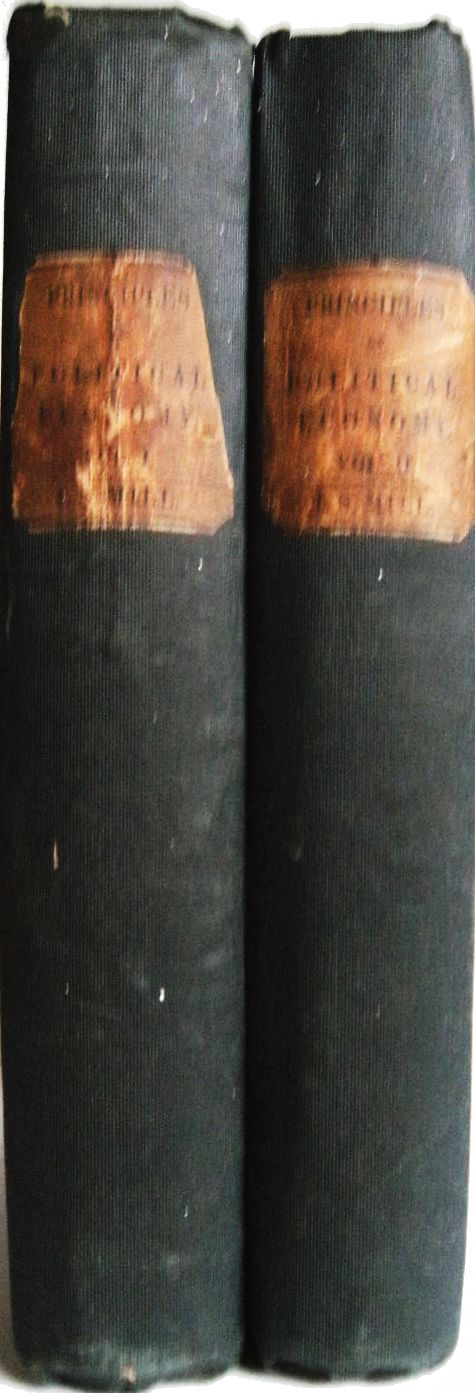 |
First edition. Mill's magnum opus, the last great synthesis of classical political economy. Though it has
been stated that it has not added much new to economic analysis it yet remained the major text book on
economics for decades and has exercised profound influence on modern English and foreign economic theory.
*Kress C.7500. Einaudi 3907. MacMinn p.69.
MISES, Ludwig von (1881-1973)
Kritik des Interventionismus. Untersuchungen zur Wirtschaftspolitik und Wirtschaftsideologie der
Gegenwart.
Jena, Verlag von Gustav Fischer 1929.
IV,[2],136p. Orig. printed orange wrappers. Small stamp (‘Deutsche Weltwirtschaftliche
Gesellschaft e. V.') below the imprint and at top of the upper wrapper, remainders of a label at top of back.
(#33524)
€ 350
First edition. A strong plea against interventionism in economic life, either in the form of communism,
socialism or fascism, or in any other form of a controlled economy. 'If socialism could not calculate, and state
interventionism only creates problems in the name of solving them, then the only viable and truly prosperous
economy is laissez faire.' An English translation under the title A critique of interventionism appeared in
1977.
*New Palgrave III,p.480.
|  |
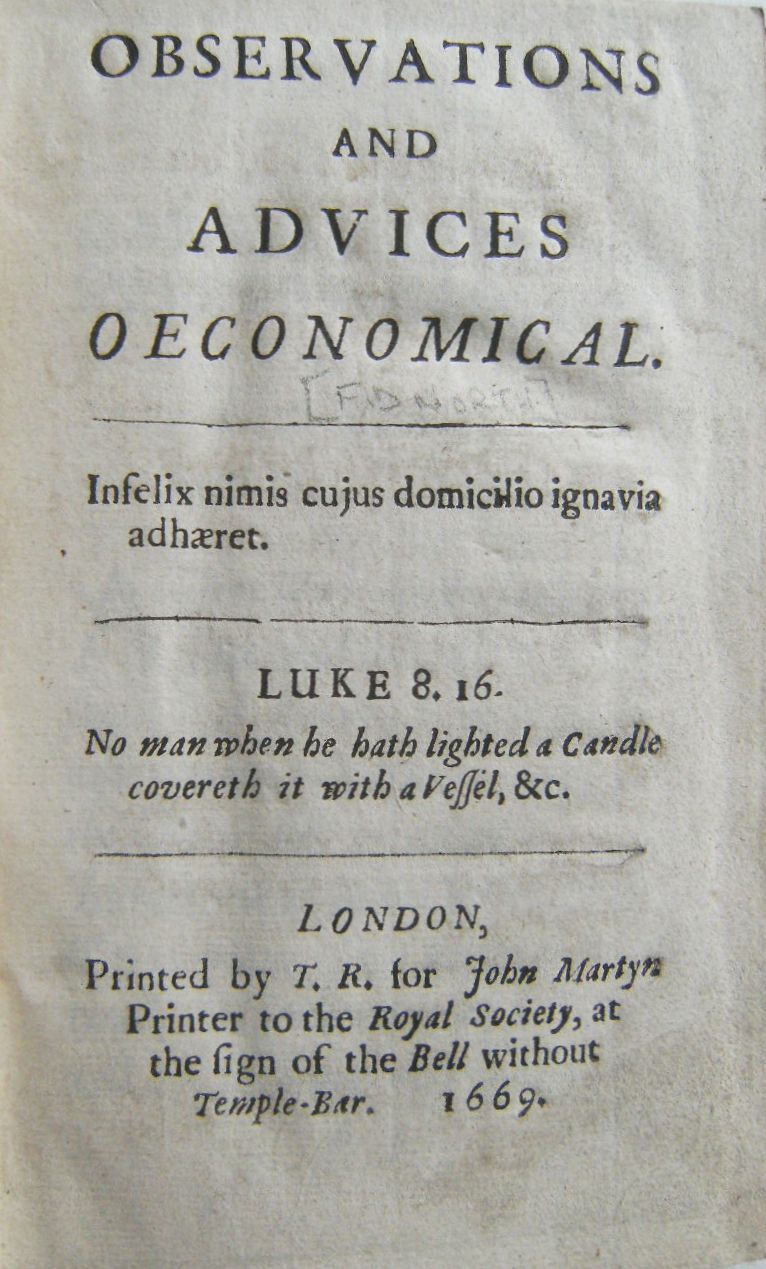
[NORTH, Dudley, 4th Baron North (1602-1677)]
Observations and advices oeconomical.
London, printed by T.R. for John Martyn, printer to the Royal Society 1669.
Small 8vo (15 x 9,8 cm). [XIV],132,[9]p. Contemp. calf, double-line gilt borders on both sides,
light rubbing to back and back cover, but an attractive copy. (#31956)
€ 1750 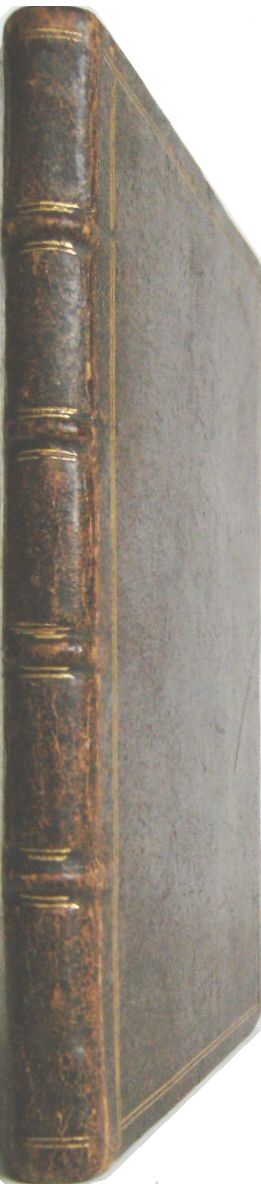 |
First (only) edition. A treatise on the management of a household. ‘Oeconomy is the art of well governing a
mans private house and fortunes, by which appears, that there is no necessary object of oeconomy, save an owner
with his house and possessions, but it is seldom exercised without wife and servants. And children will be desired
for succession sake, and as the bond or tye of affection beteween man and wife ... (p.3).'
North was a member of parliament from 1628 until, with interruptions, 1660. He was ‘an accomplished,
studious man, who wrote on economic and religious subjects'. He was the father of the economist Sir Dudley
North (1641-1691).
*Wing N1286. Kress 1245. Goldsmiths' 1918.
|  |
the administration of Spanish
AmericaOrdenanzas del Consejo Real de las Indias.
Ordenanzas del Consejo Real de las Indias. Nuevamente recopiladas, y por el Rey Don Felipe Quarto
N. S. para su govierno establecidas ano de M.D.CXXXVI.
En Madrid, por Julian de Paredes 1681.
Folio (28,5 x 20,5 cm). 206,[14 index]p. Title with fine engraved coat of arms, numerous large
and several decorated capitals and two tail-pieces. Contemp. calf, gilt back with red label, marbled edges and
endpapers. Very fine copy. (#15417)
€ 5000
 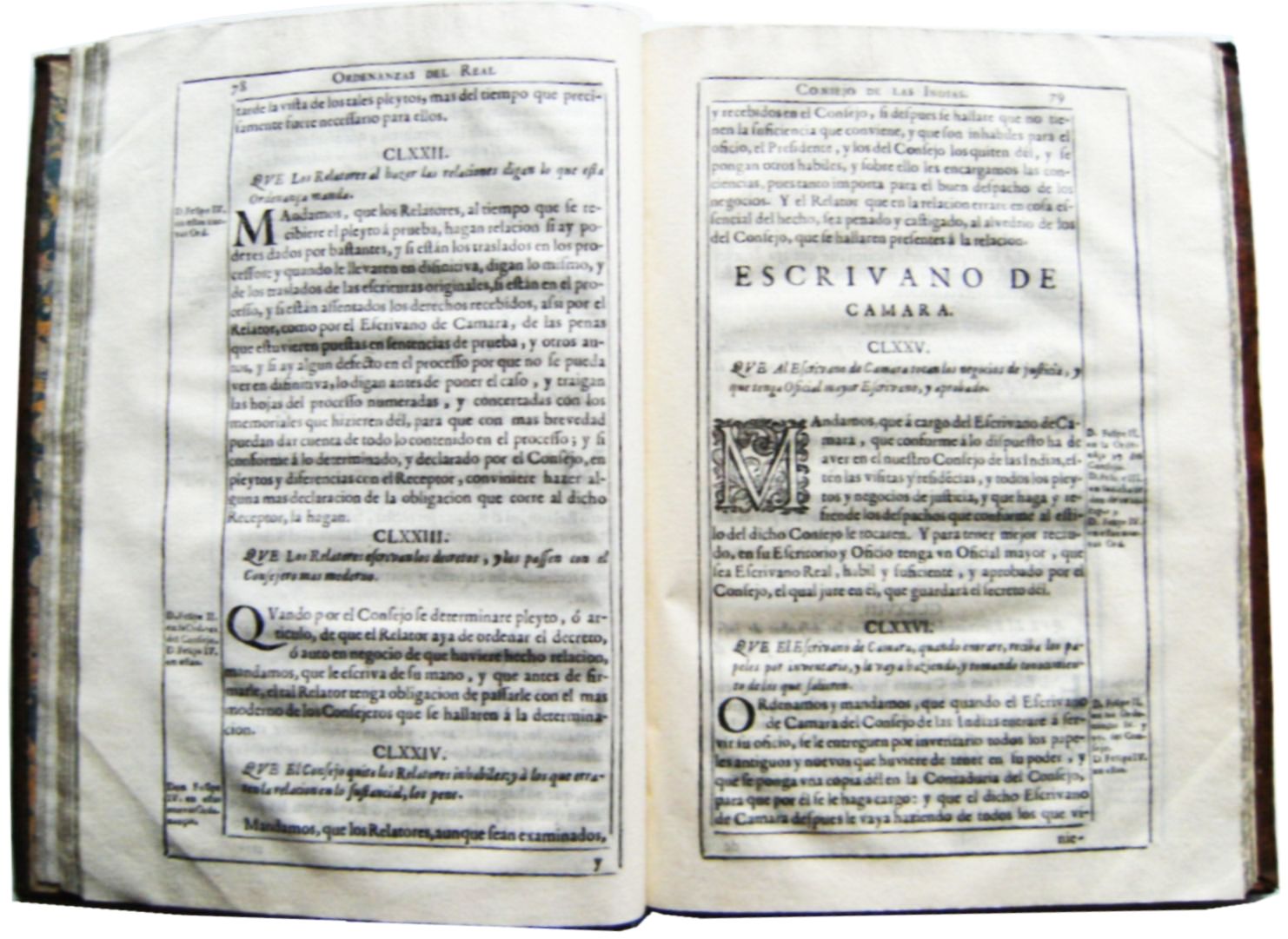 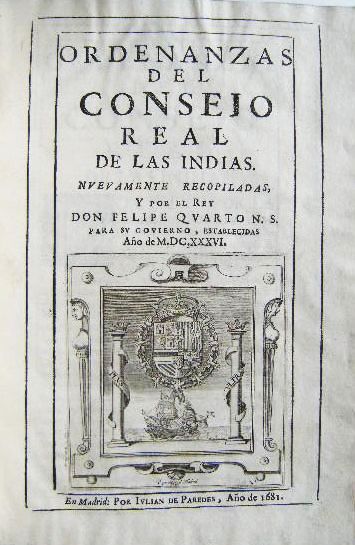
Second, revised and considerably expanded edition. The statutes of the Council of the Indies
(formally Royal and Supreme Council of the Indies), the main administrative body for the Spanish colonies in the
Indies and the Philippines. It was established in 1524 by Charles V and exercised absolute power.
The first part (p.1-112) appeared in 1636 and includes 245 ordinances. The second part (with sub-title
Autos, acuerdos, y decretos de govierno del Consejo Real y supremo de las Indias) appears here for the
first time. It includes 190 ordinances that were omitted in the earlier edition as well as ordinances for the
following period.
*Sabin 57477.
‘Undoubtedly the most eminent of the Venetian
economists of the 18th century‘ [ORTES,
Giammaria (1713-1790)]
Errori popolari intorno all' economia nazionale, considerati sulle presenti controversie fra i laici e i
chierici, in ordine al possedimento de' beni.
[Bologna, no printer] Con licenza de' superiori 1771.
4to. [II],VII,[1],118,[2 blank]p. Contemp. carta rustica, back covered with marbled paper.
Small name stamp (‘dott. Prof. Giovanni Miozzi') on first and last leaves, first leaves with some foxing spots.
Fine copy with generous margins. According to Kress, Italian printed in 200 copies only. (#31817)
€ 4500 |  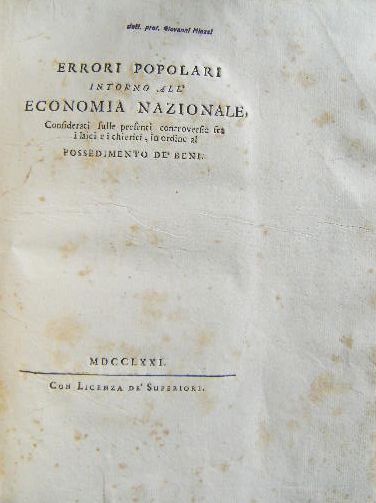 |
First edition, very rare. Ortes' first book, written ‘with the scope of upholding the existence of clerical
property in mortmain'. Ortes was a Venetian monk who left the cloister but remained in holy orders and was ever
a streneous defender of the clergy. ‘The Errori popolari itself is an attempt to treat certain economic
questions by following the procedure of a geometric treatise. He sets down certain axioms or what he believes are
‘general truths, derived from immutable and necessary principles from which there is no deviation', and to these
he opposes some of what he thinks are popular errors. From these axioms he proceeds to particular cases which
he investigates.'
‘Ortes is undoubtedly the most eminent of the Venetian economists of the last [18th] century; his genius,
original and sometimes paradoxical, is often opposed to the general tendency of the ideas of his time, and though
his researches are occasionally faulty in their method, he has left a deep impress on the history of economic
theory. He regards economic laws as immutable, like those of nature; he maintains this in opposition to the
opinion usually accepted in his time, which regarded economics only in relation to special interests. Perhaps it is
this idea which leads him to distrust the action of the state, considering it not adapted to promote the wealth of a
country. While Ortes applied a mathematical method to economics, his arguments are based throughout on
abstract theory, disregarding the study both of facts and of history as not appertaining to economic science. This
detracts from the value of his labours. Still his works are of weight in the history of economic theory.'
*Kress, Italian 403. Einaudi 4224. Mattioli 2638. Palgrave III,p.43. Theocharis p.40-43.
A classic of the Mathematical School of
economics PANTALEONI, Maffeo
(1857-1924)
Principii di economia pura.
Firenze [Florence], G.Barbèra 1889.
Small 8vo. 376p. Orig. blue cloth, very light wear to extremities. (Manuali Barbèra di
scienze giuridiche, sociali e politiche VIII) (#29858)
€ 450 | 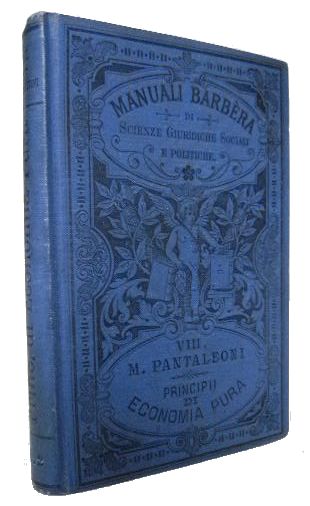 |
First edition. Pantaleoni's most important book, a classic of the Mathematical School 'which contributed to
the introduction of marginalist ideas in Italian economic thought and which ... made a considerable impression
outside Italy as well'. 'Austrian or 'Austro-Walrasian' in fundamentals, enriched by Marshall's apparatus of
foreign and domestic trade ... it gave an important lead away from old and toward new things. In this consists its
importance ... it is brilliantly written ... and is still worth reading'. A second edition appeared in 1894 and an
English translation in 1898.
*Einaudi 4280. New Palgrave III,p.794. Schumpeter p.857. Batson p.30.
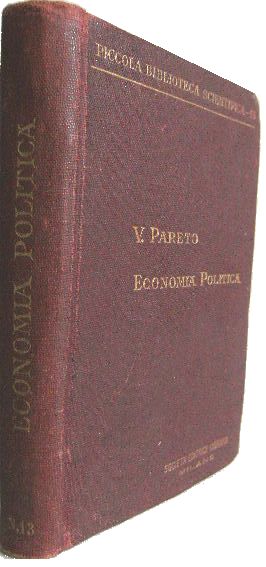
PARETO, Vilfredo (1848-1923)
Manuale di economia politica con una introduzione alla scienza sociale.
Milan, Società Editrice Libraria 1906.
Small 8vo. XII,579p. Orig. dark red cloth, gilt lettered, red edges. (Piccola Biblioteca
Scientifica 13) (#23341)
€ 900 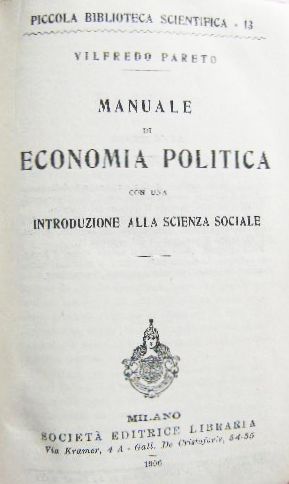 |
First edition. Whereas Pareto's Cours was 'simply a brilliant Walrasian treatise', and also the
Manuale is 'not more than Walras work done over... [it is] however done over with so much force and
brilliance as to grow into something that deserves to be called a new creation'. 'It is better conceived and, more
important, much better thought through than the Cours d'économie politique. It is basically a work
of synthesis in which Pareto presented a general theory of economic equilibrium which is considerably more
refined than Walras's.'
*Schumpeter p.858-861.
|  |
 |
POPPER, Karl (1902-1994)
On Carnap's version of Laplace's rule of succession.
[No place] 1962.
[2],69-73,[1]p. Self-wrappers, stapled. (#41167)
€ 250 |
Original offprint from Mind: a quarterly review of psychology and philosophy, Vol. LXXI, N.S.,
No. 281, January, 1962).
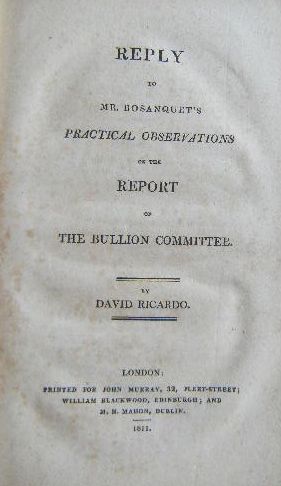
RICARDO, David (1772-1823)
Reply to Mr. Bosanquet's Practical observations on the Report of the Bullion Committee.
London, printed for John Murray; William Blackwood, Edinburgh; and M.N.Mahon, Dublin. 1811.
[VIII],141p., complete with the half-title, but without the final colophon leaf. Modern decorated
boards, back with gilt-lettered black label. Mild browning and foxing, heavier to first and last leaves. (#35133)
€ 1500  |
First edition. A vigorous defense of the principles of the Bullion Report, stating that inflation had resulted
from over-issue of currency, primarily by the Bank of England, which was contested by Charles Bosanquet in the
quoted publication.
‘This is perhaps the best controversial essay that has ever appeared on any disputed question of political
economy. In it Mr. Ricardo met Mr. Bosanquet on his own ground, and overthrew him with his own weapons ...
This tract will always be read with delight by those who are not insensible of the high gratification which all
ingenuous minds must feel in observing the ease with which a superior intellect clears away the irrelevant matter
with which a question has been designedly embarrassed, reduces false facts to their just value, and traces and
exhibits the constant and active operation of the same general principle through all the mazy intricacies of
practical detail' (McCulloch p.174).
*Kress B.5896. Goldsmiths' 20339. Mattioli 3022.
|  |
A wide-margined copy ROUSSEAU, Jean Jacques
(1712-1778)
Principes du droit politique. [Half-title:] Du contract social.
Amsterdam, Marc Michel Rey 1762.
[IV],VIII,323,[1 publ. cat.]p. With vignette (Justice seated) on title sd. B.Bolomey inv. and
C.Boily sculp. Nineteenth-century half calf, gilt back with red and orange label, marbled sides, corners little
worn. Copy with remarkably ample margins (218 x 134 mm). (#19011)
€ 6500 |  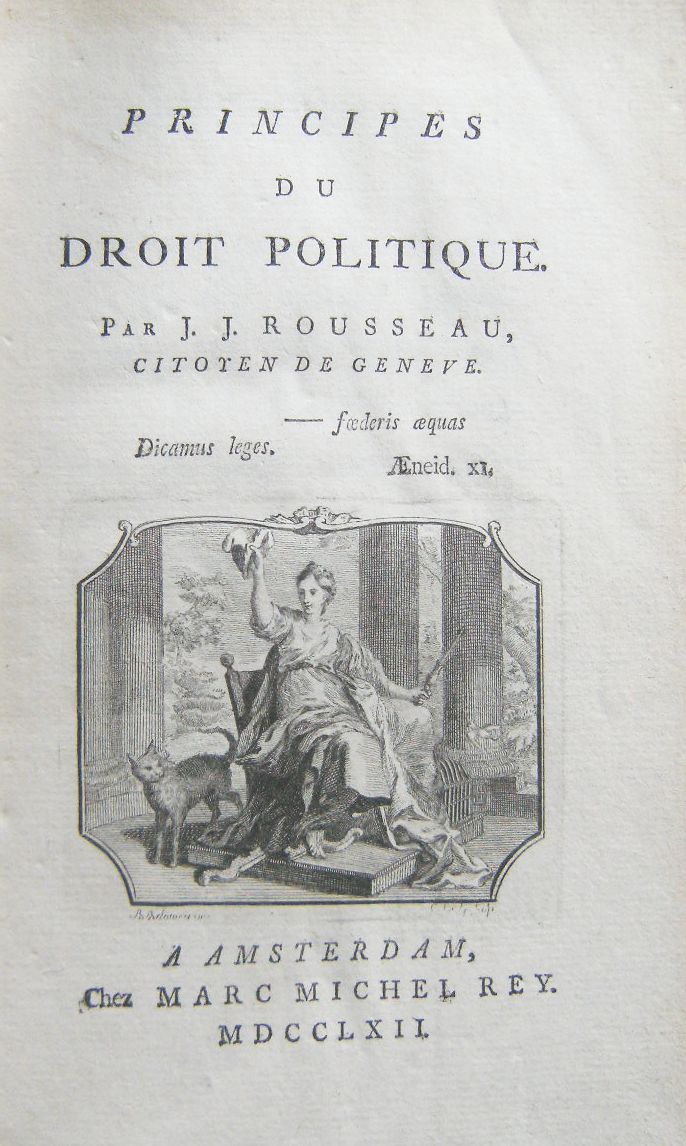 |
First edition, second issue (known as 'type B'), of Rousseau's greatest work. It is 'the first great emotional
plea for the equality of all men in the state ... a crucial document of egalitarian government'.
The printing history of this book has been amply set out by Rousseau's bibliographers T.Dufour and
R.A.Leigh at hand of the correspondence between Rousseau and his Amsterdam publisher Rey. On 6 January
1762 Rousseau suggested to Rey to use for this his new book a changed version of the vignette that was used
before for the Discours sur l'inégalité. Rey commissioned two vignettes: one showing
Justice standing with helm and balance, and one showing Justice seated with cap. Rey chose the former, but in a
letter of 28 February Rousseau disapproved of this choice because he finds the result messy. When Rey received
this letter he apparently had already started the printing. Yet he decided to meet Rousseau's wishes and made a
new title for which he used the vignette with Justice seated. This vignette however was somewhat bigger and Rey
decided to move the first three lines of the title ('Du contract social') to the half title. In the mean time he received
a new letter in which Rousseau asks for reasons of discretion to replace a note on civil marriage on pages 321 and
322 by another note, a few days later followed by another letter in which he orders to suppress this note as well.
Rey again decided to meet Rousseau's wishes and printed again pages 321-324. The suppression of the note
meant that page 324 would become blank, and Rey decided to use it for a catalogue of his books. Apparently
when these changes were made copies had either already left the printing office or were overlooked. Only few
copies of the first issue (known as 'type A') have survived.
*Dufour 133. R.A.Leigh, Unsolved problems in the bibliography of J.J.Rousseau, p.21-22.
Printing and the mind of man 207. En français dans le texte 162.
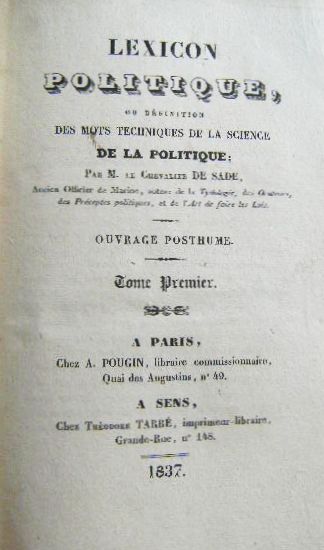
SADE, Louis de (1753-1832)
Lexicon politique, ou définition des mots techniques de la science de la politique. Ouvrage
posthume.
Paris, A.Pougin & Sens, T.Tarbé 1837-38.
4 volumes in 2. [VI],367,[12], [IV],443,[1]; [IV],383,IV, [IV],418,IIIp. Contemp. half calf,
backs richly gilt in compartments, marbled sides and endpapers. Fine set. (#28321)
€ 350  |
First (only) edition. The author was an officer in the French army and in 1789 fled to London where he
published several pamphlets against the Revolution. He returned to France in 1815 and became an adversary of
the administration of the Restoration. The present volumes include writings published earlier in the form of
pamphlets or contributions to journals as well as unpublished material. An alphabetical subject index at end of
the last volume shows a great variety, from ‘agiotage, alarmistes, amendements aux lois proposées aux
Chambres' to ‘symptômes, symptômes trompeurs, vieillards'.
|  |
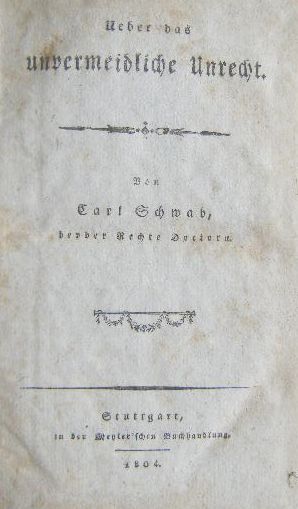
SCHWAB, Carl [Karl] (1781-1847)
Ueber das unvermeidliche Unrecht.
Stuttgart, in der Metzler'schen Buchhandlung 1804.
Small 8vo. XXXII,328p. (p.328 misnumbered 228). Contemp. marbled boards, back with label,
little rubbed. (#12132)
€ 175  |
First (only) edition. ‘A work of singular clearness and force ... entitled "Of unavoidable injustice " ... where
the author describes what he calls the Universal State, in which nations will be to each other as citizens in the
Municipal State. He is not so visionary as to imagine that justice will always be inviolate between nations in the
Universal State, for it is not always so between citizens in the Municipal State; but he confidently looks to the
establishment between nations of the rules which now subsist between citizens, whose differences are settled
peaceably by judicial tribunals' (Charles Sumner, The duel between France and Germany).
The author was ‘in beyder Rechte doctorn', and a high-ranking official and from 1831 to 1839 Minister of
Justice in the Kingdom of Württemberg.
|  |
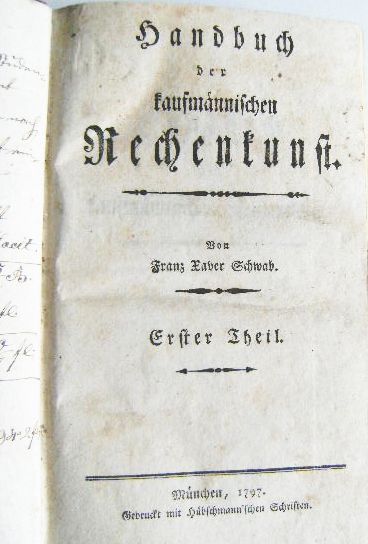
SCHWAB, Franz Xaver.
Handbuch der kaufmännischen Rechenkunst.
München, gedruckt mit Hübschmann'schen Schriften 1797-99
2 volumes in 1. [II],468, 162,[6],LXXXp. Contemp. half calf, marbled sides, yellow edges, gilt
back, little rubbed. Endpapers with ms. exercises. (#13464)
€ 750 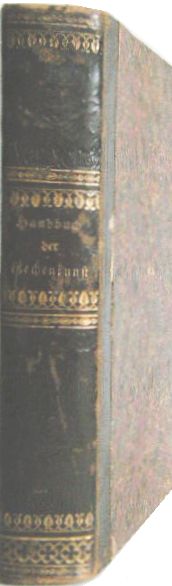 |
First edition. A handbook of commercial arithmetic, divided into chapters on theoretical arithmetic,
practical arithmetic, fractures and their addition, subtraction, multiplication and division, special cases of
calculating, interest, gold and silver calculations, weights and measures, etc. The second volume is dedicated to
bills of exchange and commodity prices. It is interspersed with exercises, with solutions at the end of the volume.
We could not find any information about the author, other than that he was the author of another book with
the title Der Rechnungs-Gehülfe für Geschäfts-Leute jeder Art (1820).
*WorldCat locates several copies of a ‘much enlarged and improved edition', published in 1821, but only a
single copy of the second volume of the present edition. GVK adds only one location of this (UB Göttingen), and
none of the second edition.
|  |
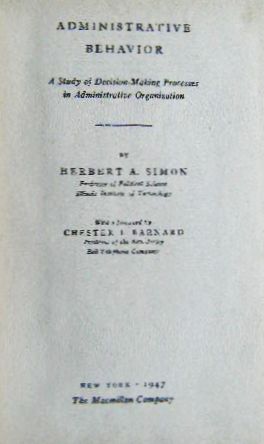
SIMON, Herbert A. (1916-2001)
Administrative behavior. A study of decision-making processes in administrative organization.
New York, The Macmillan Company1947.
XVI,[2],259p. Orig. grey cloth, minor wear to extremities. Nice bookplate to front pastedown.
(#13512)
€ 350  |
First public edition, first printing (thus stated). This edition was preceded by a preliminary edition
published by the Illinois Institute of Technology in 1945.
This is Simon's best known book, based on his doctoral dissertation. It was highly influential in the fields
of computer science, economics, and cognitive psychology. Wikipedia states that ‘as of 2016, Simon was the
most cited person in artificial intelligence and cognitive psychology on Google Scholar'.
He received the Turing Award in 1975 and the Nobel Memorial Prize in Economic Sciences in 1978 ‘for
his pioneering research into the decisionmaking process within economic organizations'.
|  |
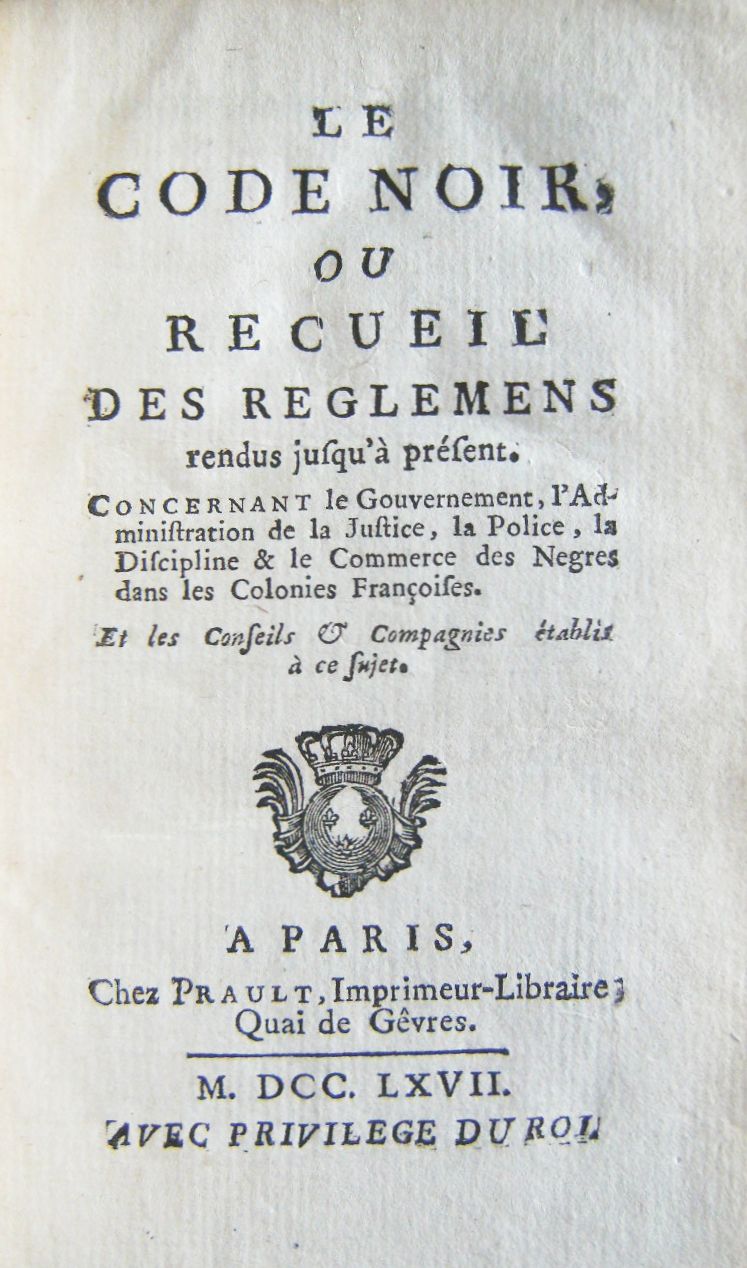
[Slavery]
Le code noir, ou recueil des reglemens rendus jusqu'à présent, Concernant le
gouvernement, l'administration de la justice, la police, la discipline & le commerce des negres dans les colonies
françoises. Et les conseils & compagnies établis à ce sujet.
A Paris, chez Prault 1767.
12mo. [VIII],446 (i.e. 468, pagination 207-216 and 375-386 used twice) p. Contemp. calf, gilt
back with label, marbled endpapers, red edges. Fine copy. (#12381)
€ 5500  |
The Black code collects all legal texts concerning slavery in the French colonies, from the first
decree of King Louis XIV in 1685 up to and including the ordinance of 1762. The edict of 1685 contained only
14 pages and subsequent editions were expanded with regulations regarding the black population and the slave
trade in the French colonies in America and Africa, Saint-Domingue (Haiti), Senegal, Cape Verde, Guinea,
Martinique, Guadeloupe, Louisiana, Canada. The title Code noir was used for the first time in the Royal
Edict of March 1724, which consisted of 55 articles regarding the colony of Louisiana. Since then it was used for
the whole collection.
The code regulated slavery, established rules for the treatment of the enslaved population, enforced the
catholic religion, protected the interests of slaveowners, and created a legal framework for racial hierarchy. It has
served as a model for other colonial powers.
*Sabin lists editions of 1718, 1727, 1742, 1743, 1752, and the present one (14125). Kress has an edition of
1743 only. Goldsmiths' has an edition of 1765 only.
|  |
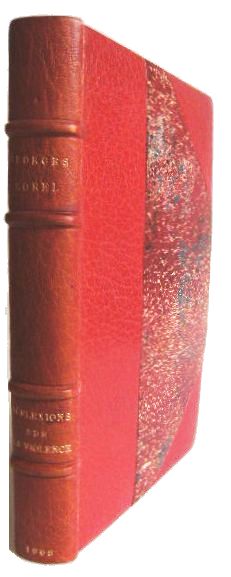
SOREL, Georges (1847-1922)
Réflexions sur la violence.
Paris, Librairie de Pages Libres 1908.
XLIII,[1],257p. Contemp. half red morocco, gilt-lettered back, orig. printed wrappers
preserved, sprinkled endpapers, top edge gilt. Tiny spot on title. Very fine copy. (#30348)
€ 350
First edition. A seminal book for early twentieth century political theory, of great importance for both
Marxists and fascists. Sorel advocated violence as a revolutionary force, where reformist parliamentary politics
had failed.
‘While until 1900 he had believed that this path of institutional development was best served through
political engagement in parliamentary democracy, his ideas changed in the beginning of the century. Partly in
reaction to the republican triumph in the 1902 French elections, and partly in virtue of new analyses on the
emergence of welfare capitalism, he now believed that prolonged involvement in bourgeois parliamentarism
would spell the death of the revolutionary working class. He thus elaborated a change of strategy, linked to the
new circumstances. Since class is not produced by the evolution of capitalist economy, then a sustained practice
of highly ideologically-charged social conflict - the grève prolétarienne - can maybe restore the
conditions ideal for a revolutionary working class to thrive.'
|   |
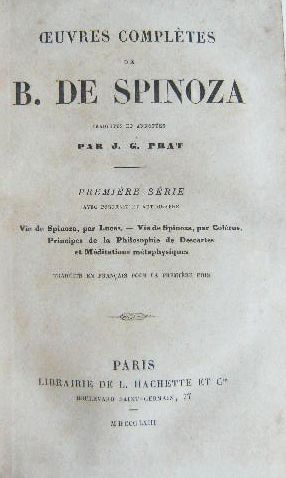
SPINOZA, Baruch (1632-1677)
Oeuvres complètes. Traduites et annotées par J.G.Prat. Première
série: Vie de Spinoza, par Lucas, Vie de Spinoza par Colérus, Principes de la philosophie de
Descartes et Méditations métaphysiques traduits en français pour la première fois.
Deuxième série: Traité théologico-politique.
Paris, Librairie de L.Hachette 1863-72.
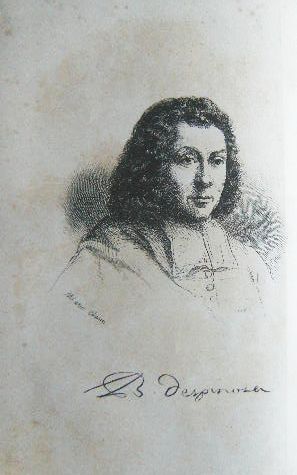
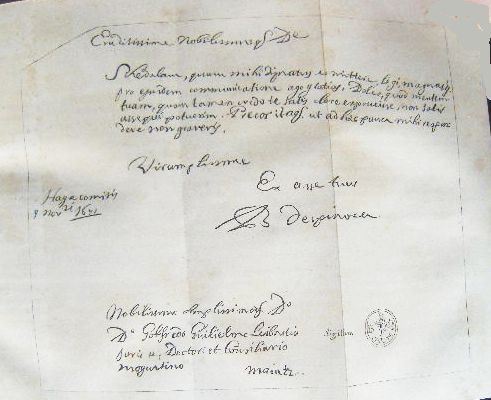
2 volumes. [IV],XXIII,[1],CXXXIII,[3].251,[1]; XX,[1],432p., 1 leaf of preface disorderly
bound. With lithograph portrait and folding facsimile. Contemp. half cloth, marbled sides. (#37253)
€ 350
All published of this rare edition which was planned in six parts. Lucas' biography first
appeared 1719 and is here republished for the first time. Colerus' biography first appeared 1706 and was soon
translated into English and German. Spinoza's work on Descartes is here translated into French for the first time.
The theological-political treatise had appeared in French already in 1678, in a poor translation by De Saint-Glain,
'no page without error or without contrary sense'. A new translation by Emile Saisset appeared 1842.
*Van der Linde 46. Wolf 344.
STACKELBERG, Heinrich von
(1905-1946)
Marktform und Gleichgewicht.
Wien und Berlin, Verlag von Julius Springer 1934.
VI,138,[2]p. Orig. printed wrappers, back and margins a little frayed. Small signature dated
1942 on title. (#33536)
€ 450 | 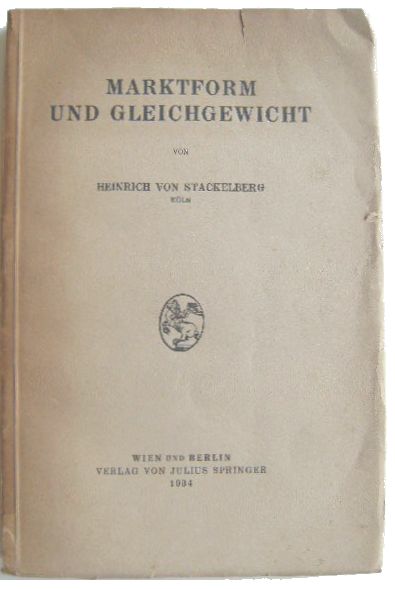 |
First edition. Habilitation thesis of 'the most gifted theoretical economist in Germany during his time'. It
'had a lasting influence on price theory ... comparable with Chamberlin's Theory of monopolistic
competition and Joan Robinson's The economics of imperfect competition, but goes further in the
analysis and in mathematical rigour'. An English translation Market structure and equilibrium appeared
2011.
*New Palgrave IV,p.469.
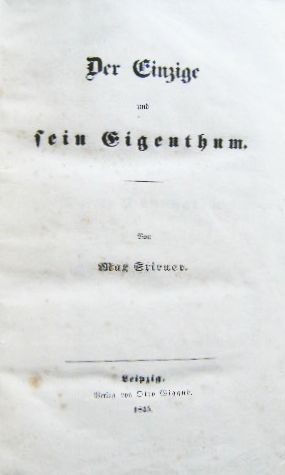
The ‘bible' of individualist anarchist
literatureSTIRNER, Max [Johann Kaspar Schmidt]
(1806-1856)
Der Einzige und sein Eigenthum.
Leipzig, Verlag von Otto Wigand 1845 [i.e. 1844].
[II],491,[3]p. Contemp. embossed cloth. A very nice copy. (#20506)
€ 4500 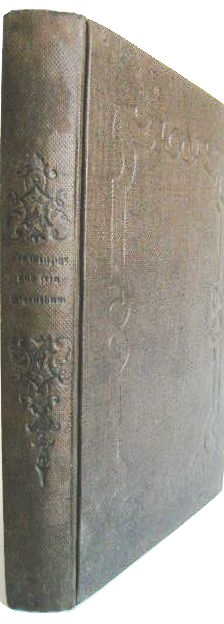 |
First edition. The 'bible‘ of individualist anarchist literature which was translated into many
languages. Max Stirner, known for his translations of the works of great classical economists like Smith and Say,
belonged to the leftist group of adherents of Hegel, which also included Feuerbach and Bruno Bauer. Inspired by
among others Proudhon Stirner developed an extreme individualism and absolute egoism, excluding all religious
and moral duties and restrictions. For Stirner the ego is the only reality, and egoism the only real principle, hence
no authority whatsoever can be accepted. Stirner's book, now a classic, has becomen the basis for all later
individualist anarchist writers.
*Nettlau p.35. Stammhammer I,p.241. Menger c.368. Humpert 9388.
|  |
ZUCCOLO, Lodovico (1568-1630)
Dialoghi ... De'saluti. Della eminenza della pastorale. Della bellezza. Della detta, e della disdetta.
Della vergogna. Della clemenza. Della gelosia. Del flusso, e riflusso delle virtu, e de'vitij. Della città
Felice. Dell' amore scambieuole fra'cittadini. Del piacere. De'terrori panici. Della republica d'Evandria. Della
republica d'Utopia. De'varij fini degli huomini. Ne'quali con varietà di eruditione si scropono nuoui, e
vaghi pensieri filosofici, morali, e politici.
In Venetia, appresso Marco Ginammi 1625.
4to. [XL],278,[2 blank]p., lvs a3 and a4 bound between b4 and c1. With woodcut priner's
device on title and numerous woodcut initials. Contemp. carta rustica. Uncut with ample margins, upper margin
unopened, vague water stain in blank outer margin throughout, small loss in lower margin of b4, far from printed
text. (#38663)
€ 1250 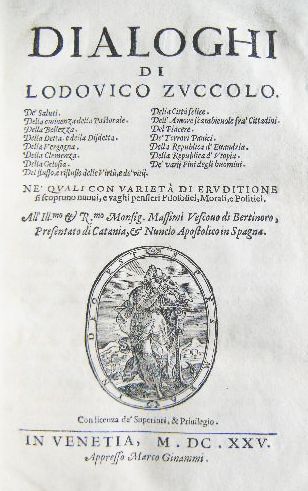 |
Second much augmented edition. A first edition of 1615 was a small volume containing seven dialogues
only. The present edition is the first to include the important commentary on Thomas More's Utopia, as
well as Zuccolo's own ‘utopia': Il porto overo della Republica d'Evandria.
‘Zuccolo was read widely and achieved some fame in early modern Europe through his Aristotelian treatise
on reason of state. The interpretation of Zuccolo as the author of
a couple of utopian writings is of particular interest for the study of the relationship with the
mainstream discourse of reason of state. In Evandria Zuccolo combines the use of stylistic and
structural elements of the utopian genre with the development of a republican theory based on civic virtue and
public education.' (S.Saracino)
|  |
ZüRCHER, Felix Leonti.
Arithmetica, oder Rechen-Kunst, durch kurze Reymens-Regeln, derselben Erklärung und
Uebung in gebührender Ordnung vorgetragen, und durch Einleitung verschiedener und seltsammen
Lehren: samt Zusatz von der Gabel-Kunst, und Vergleichung des Gelds- der Gewicht- Ellen- Schuhen- Wein, und
Korn-Määsses. Zu dem allgemeinen Nutzen wohl eingerichtet. Zweyte Auflag. Mit Erlaubnitz der
Obern.
Gedruckt zu Zug, bey Johann Michael Blunschi 1777.
[IV],488,[4]p. With several woodcut ills, incl. some full-page. Contemp. half calf, no label,
little rubbed, red edges. Small stamp at foot of title and front paste-down. (#18622)
€ 750 |  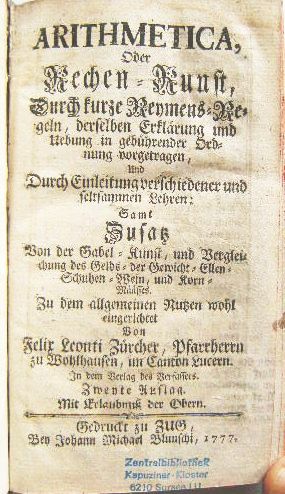 |
Second edition, probably an unchanged reprint of the first edition of the previous year, of an apparently
rare arithmetic book. A third edition appeared the next year, but WorldCat and GVK locate only copies of any of
these editions in the Niedersächsische Staats- und Universitätsbibliothek and the Zentralbibliothek
Zürich. An apparently abridged edition appeared 1823.
It is divided into six parts and an appendix: ‘Von denen 5. Species in ganzen Zahlen. Von denen 5. Species
in Brüchen. Von denen gemeinen Regeln. Von der Decimal-Rechnung. Von den Wurzeln. Von der
Wurzel-Rechnung'. The author was a pastor from Wohlhausen, canton of Lucerne, but we could not find any
further information about him.
|
|